Insurance carriers and claims executives, property adjusters and large-loss professionals, risk managers and brokers overseeing coastal portfolios, property insurers evaluating catastrophe preparedness and claim management strategies, and others should read this article to learn more about:
Why quiet hurricane seasons can increase complacency even as coastal exposure and building vulnerability continue to grow.
How Florida’s code-tested buildings and New York City’s aging, largely untested stock create different wind-loss and claims environments.
How Florida’s 25% roofing rule, opening-replacement requirements, and roof permit history shape repair scopes.
Why pre-existing deterioration, ordinance and law requirements, matching, obsolescence, and documentation gaps drive disputes.
How to distinguish the Florida 25% roofing rule, FEMA’s 50% substantial damage rule, and substantial structural damage.
Which resilience measures, records, coverage reviews, and first-72-hour response plans can materially reduce losses and claim friction.
Travis draws on his property damage and large-loss consulting experience to contrast how hurricane wind claims unfold across Florida’s code-tested buildings and New York City’s aging, largely untested stock. He clarifies the repair thresholds, pre-existing conditions, and mitigation delays that most often drive disputed scopes and escalating losses.
Executive Summary
A lull in US hurricane landfalls has not reduced coastal wind exposure; it has allowed risk, aging building stock, and complacency to accumulate. Florida and New York illustrate opposite claim environments: Florida combines rigorous wind codes with complex repair triggers, while New York concentrates exceptional property value in buildings largely untested by hurricane-force winds. Across both markets, disputes commonly involve pre-existing deterioration, repair thresholds, ordinance and law requirements, matching, and delayed mitigation. Outcomes depend heavily on pre-loss preparation: verified permits and code history, current maintenance and inspection records, adequate ordinance and law coverage, documented building conditions, resilient roof and opening systems, and response resources ready to mobilize within 72 hours.
Introduction
The last hurricane to strike the United States was Milton in October 2024. The 2025 Atlantic season ended without a single US hurricane landfall, the first such season in a decade. The only named storm to reach the US coast was Tropical Storm Chantal, which came ashore in South Carolina in July with 60 mph winds. And 2026 has opened as one of the slowest starts to a season this century: four weak tropical storms and no hurricanes through the end of August, with a strong El Niño suppressing activity across the basin and NOAA's August outlook holding at a 75% chance of a below-normal season.
None of that is a trend. It is a pause. The five seasons before it, 2020 through 2024, produced a record 30 named storms in 2020 alone, 17 US hurricane landfalls, and a record five consecutive years with a major hurricane landfall. Even the landfall-free 2025 season produced three Category 5 hurricanes. One of them, Melissa, peaked at 190 mph, tying Allen (1980) as the strongest Atlantic hurricane on record, and struck Jamaica at 185 mph, matching the strongest landfall the basin has ever produced. The basin has not lost its capacity for violence. The steering patterns simply sent it elsewhere.
The exposure, meanwhile, has only grown. Cotality's 2026 Hurricane Risk Report estimates that more than $12.26 trillion in reconstruction cost value (RCV) is at moderate or greater risk from hurricane wind alone, across 32.2 million homes. Storm surge threatens another 6 million homes, representing $2.1 trillion. These figures count homes only. Add commercial property, and the real number is considerably higher. Quiet seasons do not reduce those numbers. They reduce the attention paid to them, and they quietly extend the interval since roofs, envelopes, and maintenance programs were last tested. When the landfall drought ends, it will end on building stock that is two or more years older than it was the last time it was hit.
Hurricane wind is an eastern seaboard problem, not a two-state problem. The exposure runs continuously from the Gulf Coast through the Carolinas to New England, and 2024's Helene, like Michael in 2018, showed how far inland a fast-moving storm that intensifies through landfall can carry damaging wind. This article examines that risk through the two markets that bookend the coastline and anchor the national exposure in opposite ways: Florida, where the code is the strongest in the country but the repair rules drive the disputes, and New York City, which leads every metro in exposed homes and value, and has not taken a design-level wind test in four decades. Every market in between sits somewhere on the spectrum these two define.
Two Markets, One Peril: Hurricane Risk Assessment Across Coastal Property Portfolios
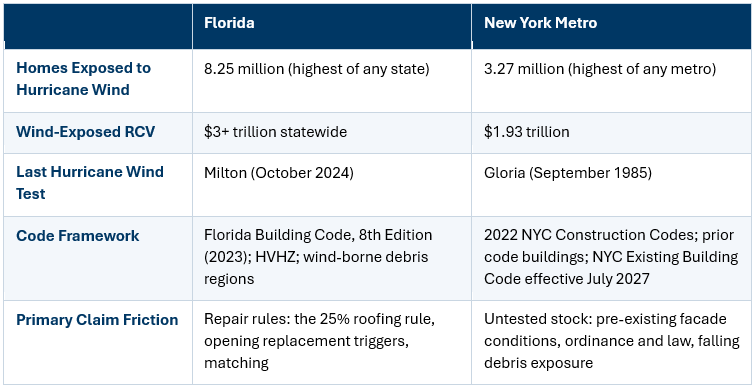
Florida is the epicenter by any measure. Cotality counts roughly 8.25 million Florida homes at moderate or greater risk of hurricane wind damage and 2.47 million at risk of storm surge, with Florida's surge exposure of $747.6 billion in RCV more than three times that of second-ranked Louisiana. Texas ranks second for wind with 4.76 million exposed homes, followed closely by North Carolina.
The less intuitive number is New York. The New York metropolitan area ranks first among all US metros for homes exposed to both hurricane wind and storm surge: 3.27 million homes exposed to hurricane wind, representing $1.93 trillion in RCV, plus 631,619 homes exposed to surge, representing another $329 billion. Hurricane frequency in the Northeast is a fraction of Florida's, but the density and value of the coastal building stock mean a single well-placed storm produces losses on a different scale.
Table 1: Florida and New York Metro hurricane wind risk comparison. Exposure figures are residential only (Source: Cotality 2026 Hurricane Risk Report).
The two markets also fail differently. Florida's claims environment is defined by a mature, battle-tested code and an equally mature set of arguments about how repairs to existing buildings must be performed. New York's is defined by an aging, largely untested stock, a city-specific code framework, and a claims community with little living memory of a true hurricane-wind event. Preparation and dispute avoidance look different in each, and that is the point of treating them together. Most coastal markets fall somewhere between the two. A portfolio built to a modern, enforced wind code that gets tested every few years will behave like Florida’s. One full of older buildings that have not seen a major storm in decades will behave like New York’s.
Florida: How Repair Rules Affect Property Damage Assessments and Decide Claims
Florida's post-Andrew code reforms produced what is widely regarded as the most stringent wind design framework in the United States. The current Florida Building Code, 8th Edition (2023), effective December 31, 2023, adopts the ASCE 7-22 wind provisions with updated wind speed maps and a revised wind-borne debris region. Miami-Dade and Broward counties make up the High-Velocity Hurricane Zone (HVHZ), where envelope products must pass the TAS 201/202/203 large-missile and cyclic pressure protocols and carry a Miami-Dade Notice of Acceptance. Elsewhere in the wind-borne debris region, generally where design wind speeds reach 140 mph, or 130 mph within one mile of the coast, glazed openings must be impact-rated or protected by approved coverings. The 9th Edition, based on the 2024 I-Codes, is scheduled for adoption in late 2026 or early 2027.
For claims professionals, the practical consequence is that Florida's building stock is layered. A home permitted under the 2007 FBC or later is a fundamentally different risk from the same floor plan built in 1995, and the code explicitly recognizes that layering in how it regulates repairs. That is where most of the friction lives.
What Wind Claims Look Like on the Ground: Key Considerations for Property Damage Assessment
Hurricane wind damage in Florida follows recognizable patterns. Shingle and tile roof coverings fail first at edges, ridges, and hips where pressure differentials are greatest, and distinguishing wind-lifted tile from tile cracked by foot traffic or installation stress is a recurring point of contention. Soffit, fascia, and gutter systems fail early, exposing the attic and roof edge to wind-driven rain. Pool screen enclosures, fences, and carports are near-universal casualties. Rooftop and pad-mounted mechanical equipment is subject to both direct wind displacement and debris impact, and compromised curb and penetration flashing becomes a source of water intrusion that is rarely traced back to the equipment without expert evaluation. And once any opening in the envelope fails, internal pressurization and water entry multiply the loss well beyond the failed component.
The single most consequential distinction in scope development is between the damage the storm caused and the repair the code requires. Florida law and the Florida Building Code answer that second question with unusual specificity, and nowhere more so than on roofs.
Florida’s 25% Roofing Rule: A Commonly Misunderstood Provision and Its Impact on Hurricane Insurance Claims
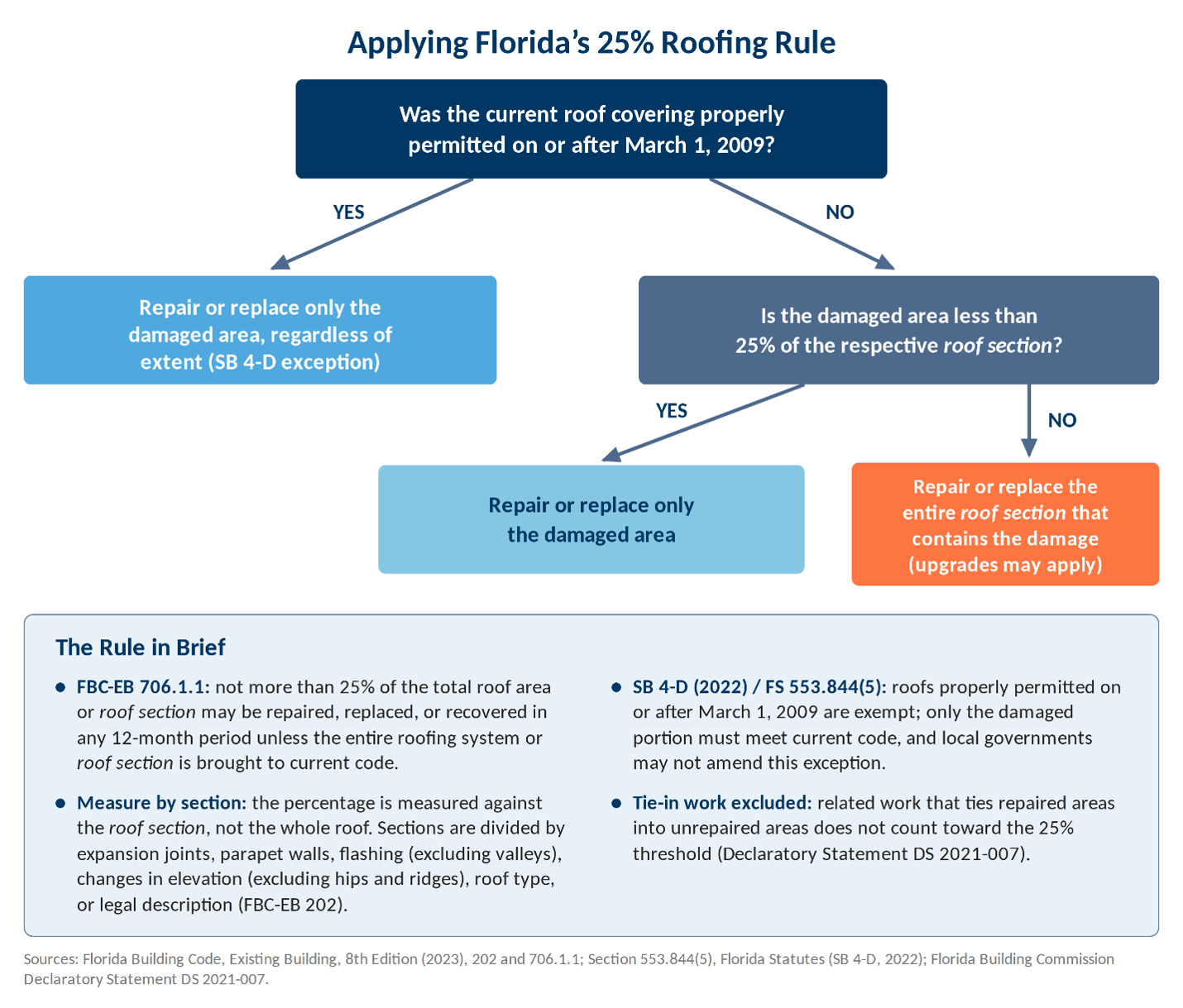
Few provisions generate more avoidable disputes than this one. Contractors routinely measure the damage against the whole roof when the code measures it against the “roof section,” a term the code defines, or count tie-in work toward the threshold when DS 2021-007 and Section 401.4 of the 2023 FBC-EB exclude it. Adjusters sometimes apply the 25% test to roofs that were properly permitted after March 1, 2009, where SB 4-D removed the test entirely. Each error runs in a different direction, and each produces a scope fight that a correct reading of the code would have prevented.
The “roof section” definition cuts both ways: even when the threshold is exceeded, only that section must be brought up to code, not the entire roof, which matters in larger homes with more than one section. The sequence in Figure 1 settles most of these arguments before they start: establish the permit history first, then the roof section boundaries, and only then measure the percentage.
Building Openings and Limits of the Repair Trigger
A parallel logic applies to the building envelope. Under the code's repair provisions, whole replacement window and door units must meet current requirements, which, in the wind-borne debris region, means an impact rating or approved protection. But replacing damaged units does not trigger replacement of existing undamaged units, and like materials are generally permitted for repairs, provided no unsafe condition is created. Scopes that sweep every opening in the building into the claim because a few failed, and scopes that deny code-required upgrades on the units that did fail are mirror-image errors. The same discipline applies to garage doors, the largest single opening in most homes, and typically the first to fail in high wind.
New York City Hurricane Risk Assessment: Four Decades Without a Wind Test
The last hurricane to make landfall on Long Island was Gloria on September 27, 1985, a Category 1 storm with 85-mph sustained winds. Even then, the official peaks were an 85-mph gust at Islip and just 51 mph in Central Park, both measured at the standard 33-foot height, with Manhattan in the weaker western eyewall. Nothing has come closer. Irene (2011) and Isaias (2020; the region’s most recent tropical storm landfall) came ashore as tropical storms, bringing downed trees and outages rather than design-level wind; Henri (2021), the remnants of Ida (2021), and Debby (2024) were rain and flood events; and Sandy, the region’s defining loss event, made landfall in 2012 as a post-tropical cyclone whose catastrophic damage was overwhelmingly a surge and flood story, not a wind story. The result is that essentially the entire modern New York skyline, its curtain wall towers, rooftop amenity decks, and mechanical penthouses, along with a vast stock of century-old masonry buildings, has never experienced design-level hurricane wind.
Put that forty-year gap next to the Cotality numbers. The nation’s largest concentration of wind-exposed residential value, $1.93 trillion in RCV, sits in a market that has not been tested by design-level hurricane wind in forty years, and the loss patterns will be inferred in real time. And the odds are not shrinking: the basin averaged four major hurricanes per season from 2017 through 2025, up from 3.2 over the prior 17 years, with rapid intensification becoming more frequent. A Gloria-track storm at modern intensity would be, functionally, a first.
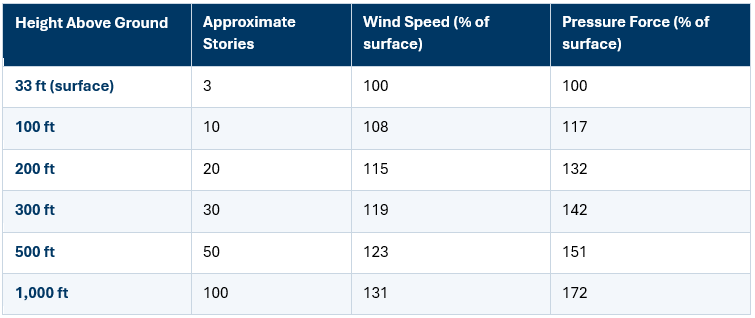
Surface readings also understate the exposure. Wind in a hurricane eyewall increases with height, and the National Hurricane Center’s mean eyewall profile puts the top of a 30-story building about 20% above the surface wind, roughly one Saffir-Simpson category, with pressure force on the facade more than 40% higher. Gloria’s 51 mph in Central Park works out to about 67 mph at the 100th floor, before any channeling between towers. In a city whose exposure is concentrated at height, that is the relevant number.
Table 2: Mean eyewall wind profile. Values are percentages of the surface wind measured at the standard 33-foot height (Source: NOAA National Hurricane Center).
Coastal Property Risk and New York’s Aging Building Stock
New York City administers its own construction codes rather than adopting the model codes outright. The 2022 NYC Construction Codes determine wind loads in accordance with the current ASCE 7 provisions, but the code also carves out special provisions for prior code buildings, and the majority of the city's stock predates modern wind design entirely: unreinforced masonry bearing-wall buildings, early curtain wall systems, and roof assemblies that were never detailed for uplift.
Unlike most of the country, New York City does not currently use the International Existing Building Code; repair and alteration work runs through the city's own framework. For claims professionals, that means the ordinance and law analysis in New York is genuinely local: what a damaged element must be restored to depends on the city code, the building's original code of record, and the Department of Buildings’ interpretation, not on the IEBC chapters that govern most other jurisdictions.
That changes on July 17, 2027, when the New York City Existing Building Code (EBC), enacted in January 2026 and modeled on the IEBC, takes effect for alteration applications filed from that date forward, and it retires the 1968 Building Code option that prior-code buildings can still elect today. The Department of Buildings expects the EBC to produce "fewer interpretation gaps" and more predictable scoping with clearer upgrade triggers. Until then, and for every loss adjusted before the transition, the analysis stays local.
Facades, Parapets, and Rooftops: Where New York Wind Claims Will Start
In a hurricane wind event, New York's losses will not look like Florida's. The dominant failure modes will be at height: masonry facade and parapet distress, coping and roof edge failures, ballasted and aged low-slope roof assemblies, rooftop mechanical equipment, water tanks, cooling towers, and the enormous inventory of temporary conditions (sidewalk sheds, scaffolding, hoists, and construction cranes) that the city carries at any given moment. Falling debris converts building damage into casualty exposure in a way that has no real Florida equivalent.
The city's safety programs are, in effect, a standing pre-loss record of exactly these vulnerabilities. The Facade Inspection and Safety Program (FISP, formerly known as Local Law 11) requires buildings taller than six stories to undergo facade examinations by a qualified professional every five years, with Cycle 10 running from February 2025 through early 2030. Since January 1, 2024, Local Law 126 has also required annual parapet observations for all buildings with parapets fronting a public right-of-way, regardless of height, and has designated unsafe conditions as requiring immediate public protection and remediation within 90 days. Owners must retain the observation reports for at least six years.
Those records will cut both ways in a wind claim. A building with current FISP filings, closed-out SWARMP (Safe With a Repair and Maintenance Program) items, and documented parapet observations presents a materially cleaner causation picture than one carrying open unsafe conditions into the storm. Deteriorated mortar joints, displaced coping stones, and corroded anchors that were flagged and left unrepaired will be the first exhibit in every pre-existing condition argument. Owners should assume that their own compliance history will be the baseline against which storm damage is measured.
Where the Disputes Will Come From
Across both markets, the fault lines in hurricane wind claims are predictable. The patterns below are the ones we see most often in the field and in appraisal and litigation support work:
Wind versus wear. Sealant, fastener, and membrane deterioration cause failures that appear storm-related but are substantially attributable to pre-storm conditions. A pre-existing condition does not eliminate coverage, but it directly affects scope attribution, and both over-assignment and over-denial are inaccurate.
Percentage-threshold fights. Florida's 25% roofing rule, the roof section definition, and the treatment of related work are the highest-volume examples, but glazing scope (which openings failed) follows the same pattern.
Ordinance and law scope. Substantial damage under the FEMA 50% rule applies to buildings in a Special Flood Hazard Area that are damaged by any mechanism, including wind, and can require elevation or reconstruction to current standards. In New York, the analysis runs through the city's own code rather than the IEBC until the city's Existing Building Code takes effect in July 2027. In both markets, ordinance and law sublimits are often inadequate relative to the rules' requirements.
Matching and obsolescence. Discontinued roofing products, weathered cladding, and equipment lines that no longer exist (aging refrigerant-platform condensers being the recurring residential example) turn component damage into system-level replacement questions.
Secondary damage sequencing. In a high-volume event, the causation chain between envelope breach and secondary interior damage must be documented, not assumed. Wet insulation, sheathing rot, and mold are predictable in a breached envelope, and scopes that leave secondary deterioration to be discovered during repair drive supplements and timeline overruns.
Documentation gaps. Buildings with current maintenance records, pre-loss photographs, and (in New York) clean FISP and parapet filings resolve faster and more favorably. Buildings without them are litigated.
Property Insurance Claims: Three Thresholds, One Recurring Confusion
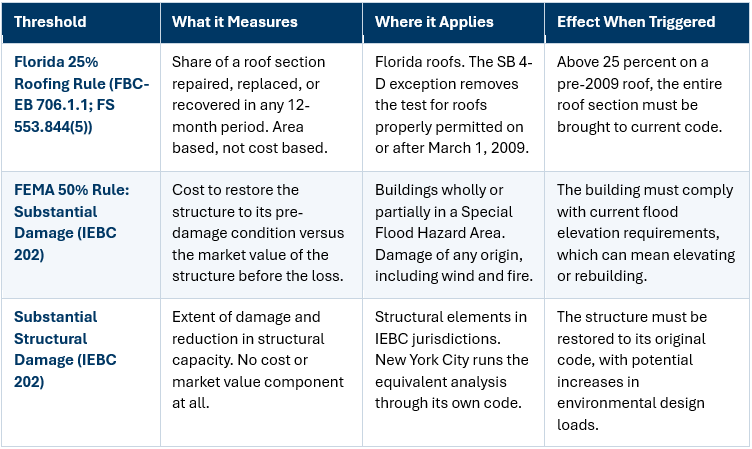
Underneath several of these disputes sits a genuine terminology problem. The 25 percent rule, the 50 percent rule, and substantial structural damage are three different tests with three different triggers, and they get conflated constantly, including by experienced professionals. Getting the wrong one applied to a loss changes the scope by six or seven figures:
Table 3: Comparison of the Florida 25% roofing rule, the FEMA 50% rule, and substantial structural damage.
A Closer Look at the FEMA 50% Rule and Its Impact on Property Insurance Claims
The 50% rule earns extra attention because it is the threshold most likely to surprise a wind claim, and because its triggers are more specific than most people assume. Four conditions have to line up: the building sits wholly or partially within a Special Flood Hazard Area (SFHA) as mapped on the FEMA Flood Insurance Rate Map, the local jurisdiction has adopted floodplain management regulations that meet or exceed NFIP minimums, the structure does not already conform to the current flood zone and base flood elevation requirements (plus any required freeboard), and the cost of restoring the structure to its pre-damage condition equals or exceeds 50% of the structure's pre-loss market value. When all four are met, the building is substantially damaged and must be brought into compliance with the flood provisions for new construction, which, for older, low-slab coastal construction, can mean elevating or rebuilding.
Two points are routinely missed. The damage can be of any origin: a roof torn off by wind, a fire, anything, not just a flood. And the rule applies whether the property carries flood insurance. Both of this article's markets are full of candidates: Florida's coastal counties, obviously, but also its inland counties, where lakes, rivers, and flat terrain put sizable areas in the SFHA, and the post-Sandy flood maps in New York, where the SFHA reaches into neighborhoods built a century before anyone drew it. Some jurisdictions have also designated additional zones, such as shaded X, as subject to the SFHA requirements through their local floodplain ordinances, so the zone determination itself is worth confirming rather than assuming.
The arithmetic on both sides of the ratio is where determinations go wrong, and the determination itself belongs to the local floodplain administrator or building official, not to the carrier, the contractor, or the owner. The repair cost side includes most of the real work: labor, materials, finishes, fixtures, appliances, HVAC equipment, and contractor overhead and profit, all priced at fair market value even where materials are donated or the owner intends to self-perform, with owner-elected upgrades or additions added on top. It excludes items such as plans, specifications, surveys, permit fees, debris removal, contents not permanently attached to the structure, and the minimum work needed to correct pre-existing code violations identified by the local authority. Repair costs can be established through itemized estimates, building valuation tables, or FEMA's Substantial Damage Estimator software.
The market value side considers the structure only, never the land, landscaping, pools, outbuildings, or driveways, and can be established through an appraisal, property tax assessment values, actual cash value estimates, or a qualified estimate accepted by the local official. Local jurisdictions can also attach a lookback window so that cumulative work over one, five, or ten years counts against the threshold, and communities have the authority to set a percentage below 50, though that is uncommon. Florida eliminated the lookback in 2025: SB 180 (Chapter 2025-190), codified at Section 163.31795, Florida Statutes, bars local governments from adopting or enforcing cumulative substantial improvement periods, so a Florida determination is measured against the current project alone.
The coverage implication is sharper for wind claims than most realize. A standard NFIP flood policy includes up to $30,000 in increased cost of compliance (ICC) coverage to help bring a substantially damaged structure into compliance, but ICC can only be accessed when flood damage exceeds the threshold. A building pushed past 50% by wind or fire must still comply, with no ICC help from the flood policy. That gap lands squarely on the property policy's ordinance and law coverage, which is exactly why O&L limits should be priced against a realistic elevation or reconstruction scope rather than a rounded default.
The practical guidance is the same in both markets: confirm the flood zone and the local floodplain ordinance before the loss, confirm with the local building department what it recognizes on each side of the ratio and what documentation it requires for each figure, and treat the elevation certificate as a pre-season document rather than a post-loss scramble.
Closing the Gap Before the Next Landfall: Reducing Hurricane Damage and Property Claims Costs
The measures that change wind loss outcomes are established, code-recognized, or voluntary, and inexpensive relative to what they prevent. The right list depends on who is holding it.
What Risk Professionals Should Verify Before a Storm
For adjusters, brokers, and risk managers, the highest-value preparation is documentary. Most of the questions that decide a contested hurricane claim can be answered before the storm exists:
Roof permit history and code of record. For Florida roofs, whether the covering was properly permitted on or after March 1, 2009, determines whether the 25% rule applies at all. Pull the permit, the closeout, and the product approvals (Florida Product Approval or Miami-Dade NOA) now, not after the loss.
Opening protection, verified rather than assumed. Confirm impact ratings or approved shutter systems for every opening in wind-borne debris regions, including skylights, garage doors, and commercial overhead doors, and ensure that shutter hardware actually exists on site and has been test-fitted.
Flood zone status and ordinance and law adequacy. Know which locations sit in a Special Flood Hazard Area on the current FEMA Flood Insurance Rate Map, what a 50% substantial damage determination would obligate, and whether ordinance and law limits reflect a realistic upgrade scope. In older buildings in either market, they often do not.
Maintenance and compliance records. Current wind mitigation inspection forms in Florida, FISP filings, annual parapet observation reports, and closed-out SWARMP items in New York. Open unsafe conditions carried into a storm become the other side's first exhibit.
Commercial roof assemblies. Roof edge securement against ANSI/SPRI ES-1 or FM standards, membrane attachment against current ASCE 7 uplift loads, equipment anchorage and curb flashing, and a roof asset register with age, warranty status, and core sample data for major commercial roofs.
A pre-loss imaging baseline. Dated photographs of roofs, facades, sealants, and mechanical systems, refreshed annually, are important. For solar and other rooftop energy assets, keep baseline imagery on record that can distinguish storm damage from pre-existing defects after the event.
Mitigating Hurricane Damage for Florida Homeowners
Opening protection remains the highest-leverage upgrade: impact-rated glazing or approved shutters on every opening, including the garage door, closes the envelope breach that drives most catastrophic residential wind losses. During reroofing, current Florida requirements already include enhanced underlayment and sealed roof deck provisions, and it is the natural moment to add roof-to-wall connectors and ring-shank deck fastening at a modest incremental cost. The IBHS FORTIFIED program provides the tiered framework (Roof, Silver, Gold) for going beyond code minimums. Florida law also requires insurers to credit verified wind mitigation features, documented through a uniform mitigation verification inspection, and the state's My Safe Florida Home program has periodically offered free inspections and matching grants for these upgrades as funding allows.
Just as important: keep the paperwork. The roofing permit, the permit closeout, the product approvals, and the wind mitigation inspection form are the documents that decide the code questions after a loss. A folder assembled in an afternoon has resolved more 25% rule disputes than any expert report written after the fact. Photograph the roof, openings, and exterior equipment once a year, and store the images off-site.
Mitigating Hurricane Damage for Commercial Property Owners in Both Markets
Wind damage initiates at the perimeter, so the commercial checklist starts at the roof edge and works inward: edge metal and coping secured to current standards, membrane attachment verified during any reroofing or recovery, and rooftop equipment anchored with sound curb and penetration flashing. Large-format overhead doors on distribution and manufacturing buildings are routine wind-failure points and warrant an explicit wind-load review. Pre-negotiated emergency response agreements with restoration contractors, with defined mobilization terms, are worth more in a regional event than any amount of post-storm phone calling.
Mitigating Hurricane Damage for New York City Buildings
The most effective wind mitigation in New York is to treat the city's compliance programs as resilience programs. Closing out SWARMP and unsafe facade conditions before the season, completing annual parapet observations and performing the repairs they identify, rebuilding deteriorated coping and roof edge details, and verifying the anchorage of rooftop equipment, tanks, and amenity structures directly remove the failure points a hurricane would exploit first. Owners with active construction should hold contractors to storm-securing plans for sheds, scaffolds, hoists, and cranes as a contractual requirement, not a courtesy. And because the ordinance and law analysis is city-specific, owners of prior code buildings should understand, before a loss, what a substantial repair would obligate them to, and whether their coverage reflects that obligation.
Everyone: Plan the First 72 Hours
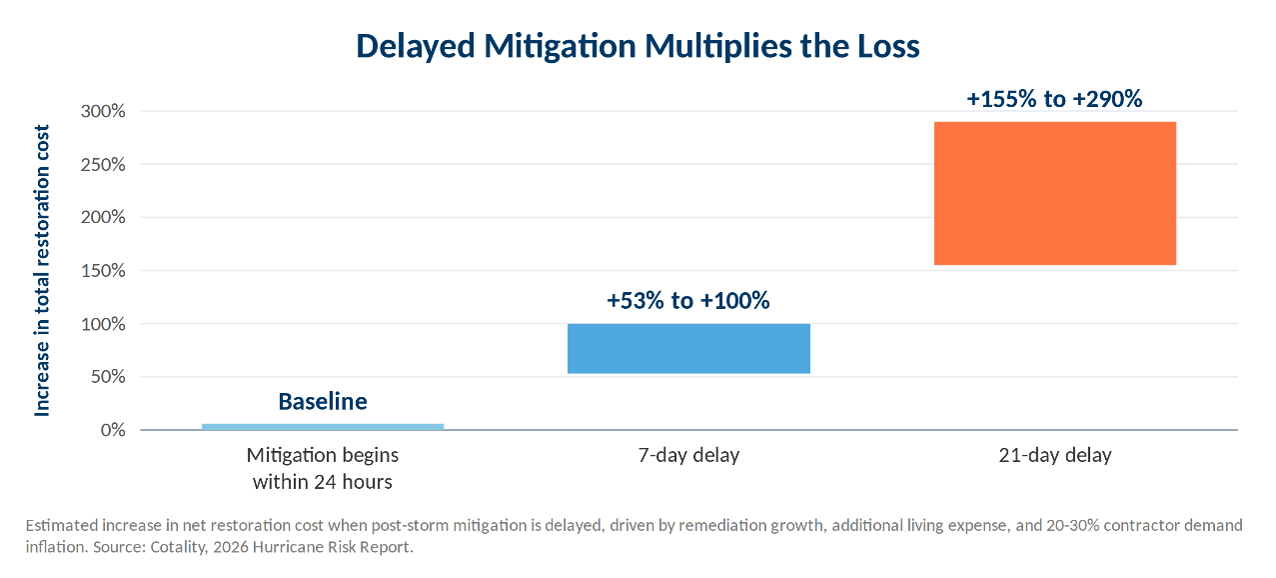
The mitigation-delay data is the strongest argument in this article. Cotality's field estimates indicate that waiting just seven days to begin mitigation increases total restoration cost by at least 53% and can more than double it, and a 21-day delay raises net cost by 155-290%, driven by remediation growth, additional living expense, and 20-30% contractor demand inflation. The difference between a roof claim and a total interior loss is usually the time between envelope breach and dry-in, and in a regional event, contractor capacity evaporates within days. Owners and risk managers should have emergency dry-in, water extraction, and remediation resources contracted before the season, with authority to mobilize within the first day. Nothing else on this list has a comparable return.
Figure 2: Estimated cost impact of delayed post-storm mitigation.
Conclusion
The Atlantic has given the United States its longest reprieve in a decade, and the 2026 season may extend it. But the absence of recent US landfalls is increasing preparedness and documentation risk, not reducing hurricane exposure. Florida will meet the next landfall with the strongest code in the country and a set of repair rules that reward the parties who understand them. New York will meet it with the largest untested concentration of exposed value in the nation and a compliance record that will double as claim evidence. In both markets, the outcome of the next major wind event is being written now, in reroofing decisions, façade repairs, maintenance files, and pre-loss documentation. The gap between code-minimum and resilient, and between documented and undocumented, is where the next cycle of claims will be decided.
Acknowledgments
We would like to thank Travis Sommerfeld, Michael Rimoldi, Keith Olsen, and Justin Pullin for their valuable insights and expertise, which greatly assisted this research.
More About J.S. Held’s Contributors
Travis Sommerfeld is a Senior Vice President in J.S. Held’s Building Consulting Practice, overseeing a regional team of professionals supporting complex property damage and construction-related assignments across the United States. With more than a decade of experience in construction and claims consulting, he specializes in damage quantification, estimating, and large-loss assessments across residential, commercial, industrial, and institutional properties. Travis manages key relationships with several of the world’s largest insurance carriers and has provided expert consulting on high-net-worth residences, high-rise structures, healthcare facilities, and university campuses. He has shared his industry knowledge through speaking engagements on building material identification, construction scheduling, wildfire assessments, and emerging technologies in the property claims industry, and is recognized for advancing technology-enabled approaches that enhance the delivery of expert services within the property claims ecosystem.
Michael Rimoldi, MPA, CBO, CFM, CBC, is a Senior Project Manager in J.S. Held's Forensic Architecture & Engineering Practice. Michael's more than thirty years of experience have been gained on both sides of the permitting counter, including service as Chief Building Official for Hillsborough County, Florida, a jurisdiction of more than 1,000 square miles and 1.2 million residents. He is a licensed building contractor, a Florida-licensed Building Code Administrator and Plans Examiner, and an ASFPM Certified Floodplain Manager. Michael is a credited reviewer of several FEMA construction-related documents, including the Coastal Construction Manual, participated in FEMA Mitigation Assessment Team operations following Hurricanes Irma and Maria, and co-authored the white papers on FEMA's commonly misinterpreted 50% rule and Florida's 25% roofing rule. He teaches building code and floodplain management courses, including as an adjunct at the University of South Florida, and has appeared on national media outlets, including CNN, Good Morning America, and The Weather Channel, discussing building codes and construction.
Keith Olsen, AIA, NCARB, LEED AP, is a Senior Architect in J.S. Held's Forensic Architecture & Engineering Practice. With thirty years of experience in architecture, including more than a decade in forensics, Keith has conducted investigations on behalf of attorneys, adjusters, developers, contractors, and owners. He is a Registered Architect in sixteen states, including New York, and holds an NCARB certificate. His practice centers on building envelope consulting, building code and accessibility analysis, and professional standard of care, with extensive experience across the New York metropolitan area on curtain wall systems, masonry facades, parapets, roofing, and historic building envelopes. Keith has provided sworn expert testimony in more than thirty depositions, arbitrations, hearings, and jury trials involving construction defects, building code analysis, and standard of care.
Justin Pullin, CCM, is the Regional Director of Forensic Meteorology at J.S. Held. A Certified Consulting Meteorologist, Justin has more than a decade of combined technical, operational, and executive experience in meteorology, spanning severe weather field research, operational forecasting, and leadership roles at NOAA and the National Weather Service, where he authored Presidential-level hurricane briefings and Executive Weather Summaries supporting multiple Presidential Disaster Declarations. He provided on-site decision support to Bay County, Florida emergency management before, during, and after Category 5 Hurricane Michael's landfall in 2018, delivering more than 100 briefings that supported the evacuation of Mexico Beach ahead of the storm. Justin serves as Commissioner on Professional Affairs for the American Meteorological Society and provides meteorology expertise to legal and insurance industry clients across the United States.
FEMA | P-213, Answers to Questions About Substantially Improved/Substantially Damaged Buildings
American Society of Civil Engineers | ASCE 7-22, Minimum Design Loads and Associated Criteria for Buildings and Other Structures
Miami-Dade County | Testing Application Standards TAS 201, 202, and 203; Notice of Acceptance program
ASTM International | ASTM E1886 and E1996, Impact Resistance of Exterior Windows, Curtain Walls, Doors, and Storm Shutters
Insurance Institute for Business and Home Safety (IBHS) | FORTIFIED Home Standard
ANSI/SPRI ES-1 | Wind Design Standard for Edge Systems Used with Low Slope Roofing Systems
Transparency Statement: Artificial intelligence tools were used to support the development of this thought leadership content, including research support, information synthesis, and editorial refinement. The analysis, insights, perspectives, and conclusions presented are those of the author(s) and reflect their professional expertise and judgment. The content was reviewed by the author(s) for accuracy, relevance, and consistency with the source materials. Artificial intelligence tools did not independently determine the content's conclusions or recommendations.
While the “25% rule” has been in the Florida Building Code (FBC) for many years, recent legislative changes, specifically within Senate Bill 4-D (2022), have clarified and/or changed the way this specific code section on...
Did you know that a residential structure is three times as likely to experience a flood than a fire over the 30-year life of a mortgage? In fact, flooding is the most common type of...
When performing inspections of buildings or structures after a catastrophic event, such as a hurricane, several types of damage conditions may be encountered. The unpredictability of storms can present many challenges when determining how to...
INDUSTRY INSIGHTS
Keep up with the latest research and announcements from our team.