Travis translates field-based storm damage observations into defensible claim strategies, showing how material behavior, maintenance conditions, and code triggers shape true loss outcomes. He highlights where scoping errors occur and which mitigation practices measurably reduce severe convective storm losses.
Executive Summary
Severe convective storms (SCS), i.e., hail, tornadoes, and straight-line winds, have become a primary driver of insured losses, with cumulative global insured losses exceeding $1.56 trillion since 2000. Texas and Illinois sit at the center of this exposure, with Chicago surpassing Dallas–Fort Worth as the most financially exposed metro area for hail risk. Field experience shows that deferred maintenance, inconsistent code enforcement, and overlooked damage beyond the roof, including HVAC systems and renewable energy assets, consistently complicate claims. Proven mitigation measures such as impact-resistant roofing, sealed roof decks, and the IBHS FORTIFIED program materially reduce losses. The gap between code-minimum construction and true resilience is where outcomes diverge.
Introduction
Severe convective storms (SCS) have moved from secondary peril to primary loss driver. Hail, tornadoes, and straight-line wind events now generate insured losses that rival, and in some years exceed, those from hurricanes and earthquakes. Aon’s 2026 Climate and Catastrophe Insight report puts cumulative global SCS insured losses since 2000 at $1.56 trillion, more than the losses from tropical cyclones, earthquakes, and European windstorms combined over the same period. In 2025, global SCS losses reached $61 billion, the third-highest annual total on record. 2025 also marked the sixth consecutive year that total insured losses from natural disasters exceeded $100 billion.
Two states sit at the center of that exposure. Texas and Illinois each present a distinct combination of risk concentration, building stock, and regulatory environment that property owners, insurers, and risk professionals need to understand. What follows is a working perspective on the current risk landscape in both markets, what we see in the field after major events, and the mitigation measures that change loss outcomes.
The Risk Landscape
Cotality’s 2026 Severe Convective Storm Risk Report identifies more than 43.5 million US properties (roughly 42 percent of those analyzed) sitting in moderate or greater hail risk categories, with a combined reconstruction cost value above $17.8 trillion. Activity is rising. Cotality reported 142 days of hail (two inches or greater) across the country in 2025, against a 20-year average of 122. At a 500-year return period, modeled losses from a single extreme hailstorm reach $58 billion of a $71 billion all-perils total. That is hurricane-scale exposure from a peril most portfolios still treat as secondary.
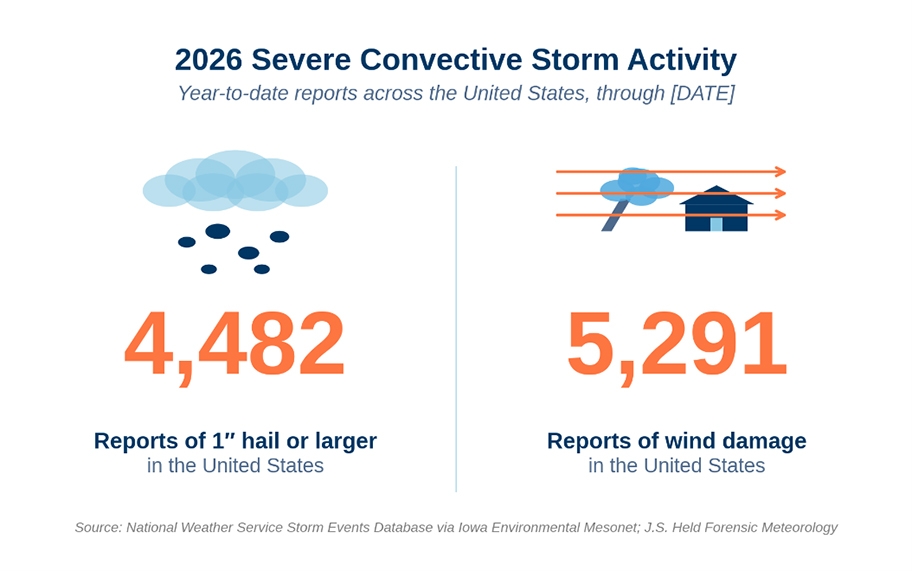
Figure 1 - 2026 severe convective storm activity.
Texas
Texas leads every meaningful measure. Nearly eight million Texas properties carry moderate or greater hail exposure, representing $3.1 trillion in reconstruction cost value. Between January 2012 and January 2024, the state averaged 197 days per year of large hail (1.0 inches or greater), 49 days of reported tornadoes, and 176 days of damaging thunderstorm winds. No other state matches that profile across all three sub-perils. The June 2023 storm cluster clearly shows the financial potential. Over five days, hail greater than one inch in diameter affected more than 680,000 Texas homes, generating estimated insured losses of $7-10 billion. Had the same footprint tracked 15 to 20 miles north into the Fort Worth metro core, modeled losses would have reached approximately $30 billion.
Texas also presents a complicated regulatory geography. The Gulf Coast operates under the Texas Windstorm Insurance Association (TWIA) program, which ties insurance eligibility to demonstrated code compliance. As of April 1, 2026, new construction and qualifying repairs in TWIA Designated Catastrophe Areas must comply with the 2024 IRC and 2024 IBC. Inland Texas operates under a patchwork of locally adopted codes with inconsistent enforcement histories. Construction era and code year alone, in either zone, are unreliable proxies for actual resilience.
Illinois and the Chicago Anomaly
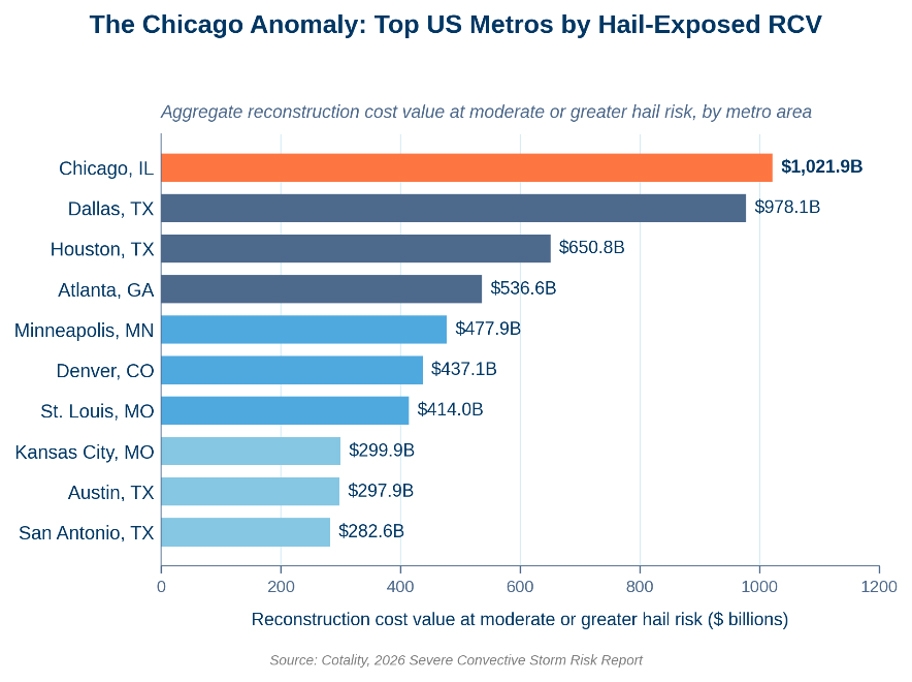
Illinois is the less obvious story, and the more interesting one. The state averaged 23 tornado days per year between 2012 and 2024 and recorded 458 confirmed tornadoes from 2020 through 2024, second only to Texas over that span. More importantly, when hail risk is measured by aggregate reconstruction cost value rather than event frequency alone, the greater Chicago area carries $1 trillion in RCV at moderate or greater risk, which Cotality calls the “Chicago Anomaly.” That figure surpasses Dallas-Fort Worth as the most financially exposed metropolitan area in the country. Illinois ranks second nationally in total hail-exposed RCV at $1.5 trillion.
Figure 2 - The Chicago Anomaly: top US metros by hail-exposed RCV.
Compounding the exposure is the state’s code history. Until January 1, 2025, Illinois had no statewide minimum for building code adoption. Counties and municipalities were required to adopt a code and inform the state, but the standard varied widely across jurisdictions. A significant portion of the state’s residential and commercial stock was built under codes that lacked current wind design provisions. Public Act 103-0510 changed that, requiring every municipality and county to adopt a code at the current edition (or the immediately prior edition) of the ICC’s International Building Code and International Existing Building Code. The practical implication for claims is direct. A major SCS loss on an older Illinois property may now trigger the first code compliance review that property has ever faced, with material consequences for repair scope and ordinance and law costs.
What We See in the Field
Risk numbers explain why portfolios in Texas and Illinois carry the exposure they do. However, they don’t explain what claims look like. The patterns below are what we consistently see in the field and where scope development most often goes wrong.
The Roof System
Hail damage is rarely uniform. Patterns depend on hail size, trajectory, and wind-assisted speed at impact. One- to two-inch hail (roughly the size of a hen’s egg) can carry sufficient mass and terminal velocity to compromise standard asphalt shingles (depending on the shingle thickness and quality), and damage typically falls into two categories:
Functional damage: fracturing, bruising, and granule displacement that reduces the shingle’s ability to shed water over time.
Cosmetic damage: surface marks and dimpling that may not immediately affect performance but can be significant for coverage and matching.
We routinely see damage concentrated on specific roof planes based on storm track and wind direction at impact, while adjacent planes show little or none. Uniform replacement scopes built without plane-by-plane field verification regularly overstate the actual loss.
Wind damage presents differently. Straight-line events drive uplift failures at the roof perimeter, ridge, hips, and valleys, where pressure differentials are greatest. When sheathing nailing patterns, underlayment attachment, or starter course installation fall short of current standards, those failures can extend beyond the initial point of detachment.
Commercial roofing systems exhibit distinct wind-damage modes. Membranes can peel back at corners and edges, billow or tent within the field under uplift, and detach at penetrations or perimeter conditions. On metal panel systems, fasteners can back out, and panels can disengage at seams under sustained or repeated loading, particularly where prior wear has already weakened the attachment.
Commercial low-slope assemblies (TPO, EPDM, modified bitumen) respond differently to hail than residential steep-slope systems. Impacts can produce membrane punctures, surfacing displacement, and seam stress that may not manifest as active leaks for weeks or months. Thermal cycling in the period following impact accelerates failure at impact-stressed locations. Comprehensive evaluation of a commercial roof after a significant hail event sometimes requires:
Core sampling to assess membrane and substrate condition.
Infrared thermography and moisture scanning to locate trapped water in the assembly.
Membrane testing to verify integrity at impact sites and seams.
Metal panel systems present a distinct damage profile. Hail can produce dents and dimples that do not compromise waterproofing performance but generate contested cosmetic disputes. Standing seam systems are generally more resilient than exposed-fastener systems, where fastener seals can be compromised by repeated hail impacts. Determining whether damage is cosmetic or functional on a metal roof requires evaluation of the specific panel profile, substrate condition, and coating system.
Hail size thresholds and functional damage are among the most common points of dispute in SCS claims. Different roofing materials carry different functional damage thresholds, and a standard three-tab asphalt shingle and a Class 4 impact-resistant shingle rated under UL 2218 respond very differently to the same hailstone. Accurate damage assessment requires knowledge of both the storm characteristics at the property and the specific roofing material installed, including its impact resistance rating, if any.
The Maintenance Factor
Deferred maintenance is the most consistent driver of disputes we see in the field. A storm of given intensity produces predictable damage to a well-maintained structure. The same storm on a structure with accumulated maintenance deficiencies produces materially different and disproportionately worse outcomes. The pre-loss vulnerabilities we encounter most often include:
Deteriorated flashing and caulking at roof edges, penetrations, skylights, chimneys, and parapets, where water pathways existed before the first hailstone fell.
Aged commercial roof membranes with reduced elasticity, granule adhesion, and seam integrity, where hail produces materially greater damage than the same impact would on a maintained membrane.
Failed or missing fasteners and clips on metal siding, soffit panels, and coping, where wind events produce failures that look storm-related but are substantially attributable to pre-storm condition.
Clogged gutters and deteriorated drainage that create ponding, ice dam conditions, and water backup at roof edges, with storm-volume rain producing interior damage partly attributable to maintenance.
Unrepaired prior storm damage that complicates scope attribution in subsequent events and often requires forensic analysis of weathering patterns and material condition to resolve.
Unpermitted and non-compliant work can also be an issue, depending on prior scope and level of non-conformity.
A pre-existing condition doesn’t eliminate coverage, but it directly affects scope attribution. A scope that assigns all damage to the current event without addressing prior conditions is not accurate. A scope that overcorrects and denies legitimate storm damage based on any prior deterioration is equally inaccurate. The distinction requires expert evaluation that understands both construction conditions and storm damage mechanisms.
Beyond the Roof
While the roof draws most of the attention in SCS claims, the failures that produce the largest total losses often occur elsewhere.
Soffit, fascia, and gutter systems frequently fail first in high-wind events. They’re designed for aesthetic and functional performance under normal loads, not sustained wind. When they go, they expose the roof edge, wall-to-roof connection, and attic ventilation openings to direct wind and water intrusion. A soffit detachment that looks minor on initial inspection can produce significant interior damage before the next rain event, and the sequence of that secondary damage is a common source of scope disputes.
Commercial wall assemblies are a meaningful source of SCS damage that receives less attention than roofing. ACM (aluminum composite material) panels can dimple under hail impact, glass curtain wall systems can sustain frame deformation and seal failure under wind pressure, and EIFS (exterior insulation and finish systems) can develop impact craters that expose the underlying substrate to moisture. Precast concrete facades and other assemblies behave differently, and each requires material-specific assessment that doesn’t generalize across building types.
Windows and glazing present differently depending on storm type. As it concerns documentation, tornado debris causes straightforward impact damage. Hail impacts on standard glazing are more variable. Impact marks on frames, screens, and glazing are documentable evidence of storm exposure, but the more consequential question is whether the glazing seal has been compromised, and water infiltration has begun, which requires physical inspection and sometimes testing.
Exterior mechanical equipment is routinely damaged and overlooked in initial scoping. Soft aluminum fins on evaporator and condenser coils are vulnerable to even moderate hail, and larger or denser hail can extend damage to the unit chassis. Fin damage can reduce system efficiency in ways that do not show up immediately and may shorten equipment life, and the fin damage pattern can serve as a useful forensic indicator of hailstone size at the site. On commercial buildings, rooftop HVAC introduces a second point of vulnerability at curb and thru-deck flashing, where storm-compromised seals are a frequent source of post-event water intrusion that isn’t traced back to the equipment without expert evaluation.
One of the biggest residential misses we see is the R-22 condenser unit. R-22 production and import in the US were prohibited under the Clean Air Act as of 2020, and new R-22 systems haven’t been manufactured for years. When an R-22 condenser sustains hail damage requiring replacement, replacement-in-kind is rarely practical. R-410A and R-454B cannot be substituted into an R-22 system because their operating pressures, lubricants, and components are incompatible; therefore, a full system replacement with a current refrigerant is generally more cost-effective than sourcing legacy components. Initial scopes that address only the condenser often miss the system-level replacement required. The same dynamic is now beginning to surface with older R-410A systems, where the unavailability of compatible R-410A condensers is driving full-system upgrades to R-454B on claims we would previously have expected to settle on a like-kind basis.
Renewable Energy Assets
Renewable energy infrastructure is a growing piece of the picture, and Texas and Illinois are central states to that growth. In recent years, Texas has consistently ranked among the top US states for both total solar power generation and installed capacity, while Illinois is projected to be one of the fastest-growing solar markets in 2026, with development expected to place it among the top ten fastest-growing states. Over the last decade, the risk profile of events related to natural disasters and extreme weather has changed dramatically for renewable energy asset owners and insurers, driven by increased frequency and financial impact.
A 2019 hailstorm at a west Texas photovoltaic (PV) solar facility, Midway Solar, resulted in $70-80 million in losses and effectively established hail as a primary peril for the utility-scale solar insurance market; the exposure has only continued to grow. DNV, an independent risk assurance and engineering firm, estimates that hail-related losses on Texas solar PV facilities alone have surpassed $600 million since 2018, and the March 2024 hail event at the Fighting Jays solar farm in Fort Bend County is expected to produce remediation costs in the hundreds of millions of dollars on a single project.
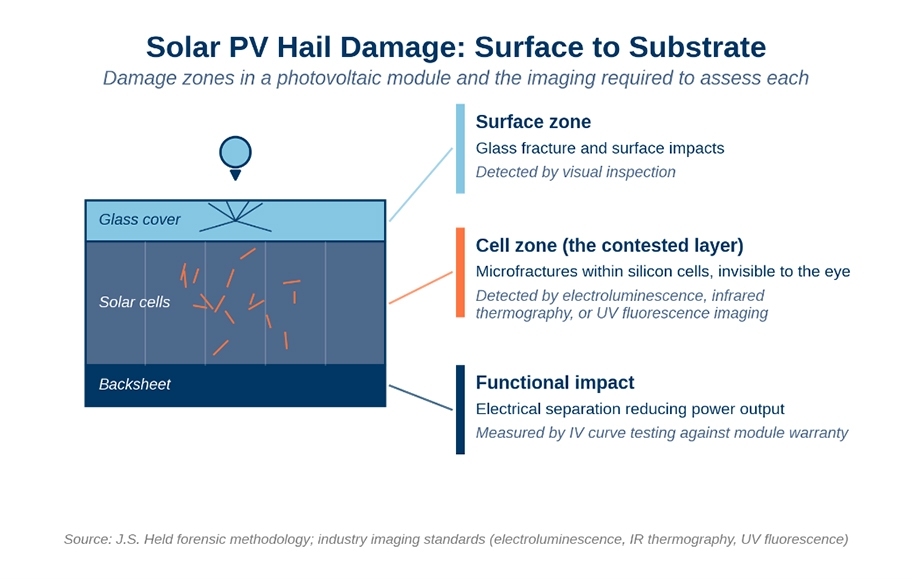
Solar PV damage includes visible glass fracture and potentially non-visible microfractures that require electroluminescence imaging, infrared thermography, or ultraviolet fluorescence imaging to detect. Microfractures can create electrical separation within solar modules, reducing power output to completely inactive cells; however, some modules with microfractures can still meet the warrantied power over the module lifetime, which is one of the more contested issues in this segment.
Figure 3 - Solar PV hail damage: surface to substrate.
Due to the size of the components and typical locations of construction, wind turbine claims have distinctive site-access and sequencing complexity. For example, in addition to potentially long lead times given current global supply chain dynamics, damage to up-tower turbine components (i.e., blades, nacelles, hubs, rotors) often requires construction of access roads, crane pads, and crane mobilization, as well as seasonal scheduling exposure. Additionally, due to the size of components and the nature of wind turbine construction, historically large claims have been filed when heavy rain inundates a construction site, damaging civil works, causing erosion, flooding turbine pads and foundations, washing out access roads, causing landslides, and, ultimately, potentially delaying project completion.
Battery energy storage systems (BESS) under construction can sustain damage to (properly or improperly) staged components, either from being blown over or from flooding. Damage to BESS frequently triggers safety protocols requiring a full shutdown and inspection after physical damage, with business interruption costs disproportionate to the damage itself.
Secondary Damage
In high-volume events with constrained contractor capacity, damaged properties sit unrepaired for weeks or months after the initial loss. When a compromised roof system is exposed to multiple subsequent rain events, interior damage can escalate. Wet insulation, sheathing rot, ceiling collapse, and mold growth are predictable in a breached envelope. In commercial buildings, interior damage can affect inventory, equipment, finished spaces, and business operations, extending the claim well beyond structural repair.
Accurate scope development must account for this sequence. When interior damage is present on a claim that originated with envelope damage, the scope must address both the envelope repair and the interior restoration, with clear documentation of the causation chain. Scopes that address only the visible storm damage and leave secondary deterioration to be discovered during repair drive supplements and timeline overruns that frustrate all parties.
Ordinance and Law Triggers
SCS claims in both states increasingly intersect with ordinance and law requirements that materially affect scope and cost.
In Texas, when a storm-damaged structure in a TWIA Designated Catastrophe Area requires substantial repair, the work needed to maintain TWIA eligibility belongs in the scope. Properties in the windborne debris region face additional opening protection requirements for windows, doors, and garage doors. Inland, when a structure sustains damage at the substantial improvement threshold under the locally adopted code, upgrades to roof deck attachment, roof-to-wall connections, and opening protection may be required to bring the property into compliance. Whether the threshold is met depends on the specific loss conditions, the local code in effect, and the authority having jurisdiction's interpretation of the applicable provisions.
In Illinois, the January 2025 statewide code adoption changed the picture for older buildings. Older residential construction across Cook, DuPage, Lake, and surrounding counties commonly lacks the roof deck attachment, truss bracing, and wall bracing required by current IRC standards. The IEBC does not automatically trigger retrofits of existing construction. Rather, when damaged structural elements require replacement, the IEBC requires that the replacement members meet current structural detailing standards. In practice, that can expand the scope of a storm-loss repair beyond simple like-kind replacement, particularly on older properties where multiple structural elements need replacement after a major event.
Tornado Shelter Requirements
Tornado shelter requirements are an emerging code obligation that risk professionals working with institutional clients in either state need to understand. Since the 2015 IBC, mandatory storm shelter provisions apply in regions where the ICC 500 design wind speed reaches 250 mph, a zone covering essentially all of Texas and Illinois. Within that zone, the IBC requires shelters meeting ICC 500 standards in two occupancy categories:
Critical emergency operations facilities, including 911 call centers and fire, rescue, ambulance, and police stations.
Group E educational occupancies with an occupant load of 50 or more, including K-12 public and private schools (with limited exceptions for day care and religious education).
Illinois has independently mandated ICC 500 shelters in all new public schools. ICC 500 shelters must withstand 250 mph wind speeds, resist debris impact from a 15-pound 2x4 projectile traveling at 100 mph, and meet occupant-load requirements based on the population served.
The implications for stakeholders are direct. When a school or emergency facility sustains tornado damage requiring substantial repair, the scope may need to include shelter construction or an upgrade as a code-compliance cost, even if the property had no shelter before the loss. For existing institutional properties undergoing renovation, triggering the substantial improvement threshold can require shelter installation as part of the scope. For new commercial development in these occupancy categories, non-compliant shelter design is both a code violation and an uninsured life-safety exposure.
FEMA’s Hazard Mitigation Grant Program provides funding for qualifying ICC 500 and FEMA P-361 shelter installations, which can partially offset costs for public entities and qualifying non-profits. Texas operates a Safe Room Program offering cost reimbursement in approved counties. Working knowledge of these programs is part of what risk professionals should bring to institutional clients in SCS-prone markets.
What Actually Reduces Loss
The mitigation measures that change loss outcomes are well-established good practices, code-recognized or voluntary, and cost-effective relative to the losses they prevent.
The Roof Assembly
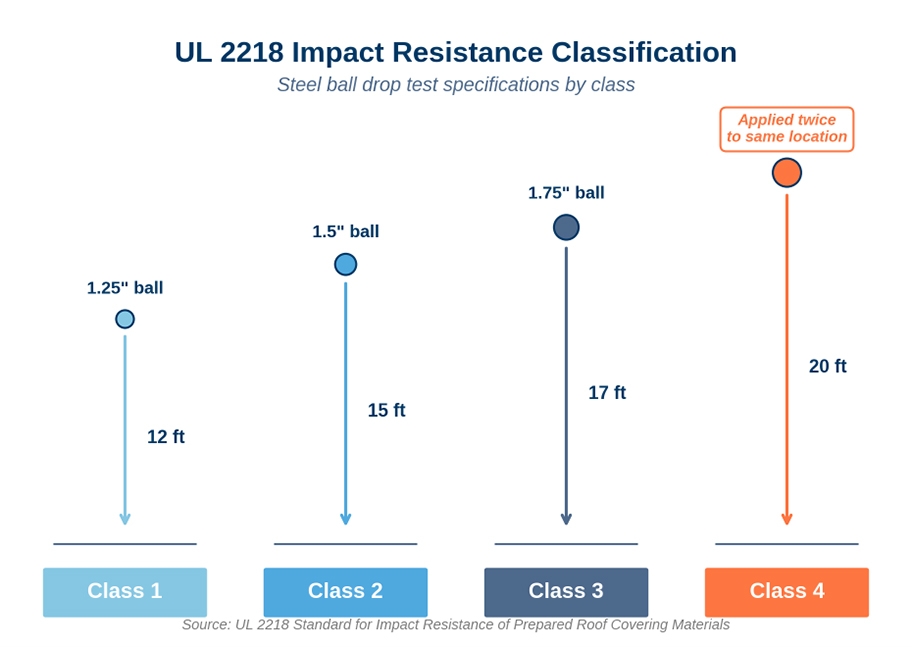
Impact-resistant roofing is the most consequential single upgrade available in hail-prone regions. UL 2218 rates roofing materials on a four-class scale based on resistance to a steel ball simulating hailstone impact (Figure 4).
Figure 4 - UL 2218 impact resistance classification.
Class 4 is the highest classification and serves as the standard against which modern SCS-resistant roofing is evaluated. Class 4 asphalt shingles use SBS-modified asphalt that flexes on impact rather than fracturing, substantially reducing the probability of functional damage from hailstones that destroy standard shingles. Texas insurers offer premium discounts of 20 to 35 percent on the dwelling portion for Class 4 roofing, and TWIA recognizes the credit through installer-completed Form PC068. For commercial buildings, FM 4473 applies to low-slope and metal roofing systems, with FM Global Property Loss Prevention Data Sheets providing additional guidance on hail resistance for membrane assemblies. Standing seam metal roofing eliminates the functional damage threshold for most hail sizes and is increasingly specified in high-risk commercial markets.
Roof deck attachment matters as much as the surface above it. The Insurance Institute for Business and Home Safety (IBHS) FORTIFIED program, a voluntary tiered resilience standard explained in the next subsection, requires:
Minimum 7/16-inch sheathing (OSB or plywood).
8d ring-shank nails as the minimum fastener (roughly twice the withdrawal resistance of smooth-shank).
Spacing no greater than six inches at panel edges and 12 inches in the field.
All nails penetrate directly into the roof framing.
Sealing the underside of the deck from inside the attic with closed-cell spray polyurethane foam at panel joints is a substantial improvement that can be added during re-roofing. For commercial roofing, deck-to-structure connection adequacy under current ASCE 7 uplift loads should be verified during membrane replacement planning, particularly on older steel deck assemblies where fastener patterns are limited.
A sealed roof deck or full-coverage ice-and-water shield protects the structure during the period between initial damage and repair, which in high-volume events is often the difference between a roof claim and a total interior loss. The 2024 IRC requires secondary water barriers in high-wind regions, and TWIA incorporates sealed deck requirements in its windstorm certification process.
Wind damage consistently initiates at the perimeter, so roof edge details are central to overall envelope performance:
Metal drip edge at eaves and rakes, extending at least one-half inch below the sheathing and two inches up the roof surface.
Underlayment applied over the drip edge at eaves and under it at rakes, per IRC requirements.
Starter strips fastened at the spacing required for the applicable design wind speed.
In TWIA areas, edge metal and sealing details verified through windstorm certification.
In commercial buildings, parapet walls, coping, and edge metal are common failure points during high-wind events. Properly anchored systems designed to current FM or ANSI/SPRI ES-1 standards materially outperform older specifications.
The IBHS FORTIFIED Program
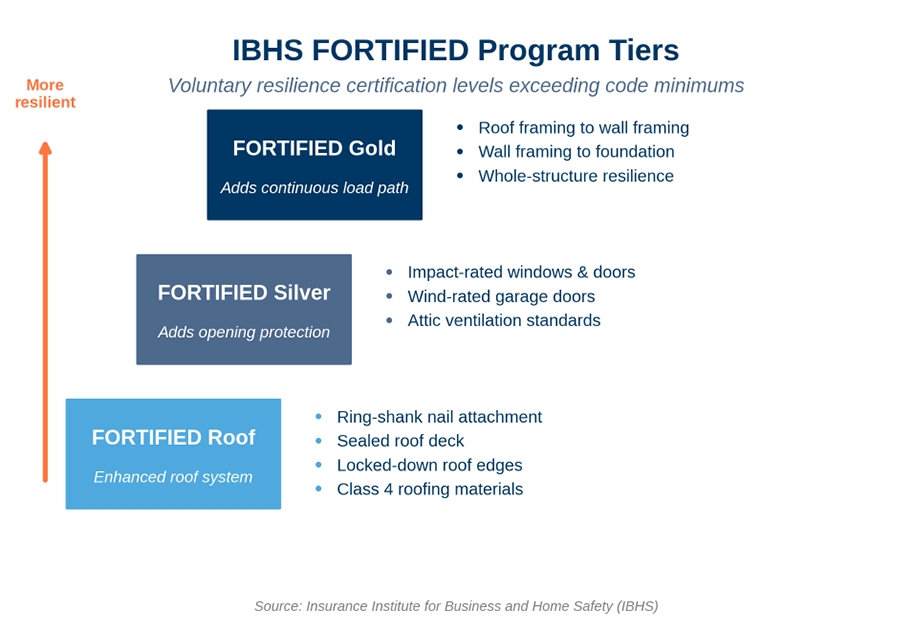
The FORTIFIED program provides a voluntary, tiered certification framework for wind and hail resilience that exceeds current building code minimums (Figure 5).
Figure 5 - IBHS FORTIFIED program tiers.
FORTIFIED Gold incorporates the full continuous load path from roof framing through wall framing to the foundation, providing whole-structure resilience against wind-induced uplift and lateral forces.
FORTIFIED Silver adds opening protection for windows, doors, and garage doors with impact-rated or adequately braced products, along with required attic ventilation performance standards.
FORTIFIED Roof addresses the primary point of vulnerability: enhanced roof deck attachment with ring-shank nails, a sealed roof deck, locked-down roof edges, and Class 4 or better roofing materials. This designation is designed to keep the roof on and water out in events up to EF-2 tornado intensity.
IBHS recently updated the FORTIFIED inland standards to align more closely with hurricane-zone requirements, specifically requiring the tighter nailing pattern and tested roof vent standards for inland properties. This update reflects field research showing that construction improvements effective in coastal environments against hurricanes produce comparable performance benefits for inland structures against derechos, tornadoes, and straight-line winds common in Texas and Illinois.
Connections and Openings
The roof-to-wall connection is typically the weakest link in residential structures in inland Texas and Illinois, where roof trusses and rafters are commonly toenailed to the top plate with two or three nails. Hurricane ties and rafter straps, required by FORTIFIED at every connection, can increase uplift resistance several times over toenailed capacity by transferring loads through the wall framing into the foundation. The incremental cost of adding approved connectors during re-roofing is modest relative to the structural performance gain. For commercial structures, the equivalent question is the adequacy of roof framing-to-wall connections and the continuity of the lateral load path; steel framing with moment connections or properly detailed braced frames substantially outperforms older light-gauge systems with inadequate foundation anchorage.
Opening protection completes the envelope. Garage doors are the largest single opening in most homes and the first to fail in high-wind events. The 2021 IRC requires wind-rated design in high-wind regions, and TWIA areas require minimum pressure resistance for the applicable design wind speed. Impact-resistant windows tested under ASTM E1886 and E1996 are required in Texas’s windborne debris regions. On the commercial side, large-format overhead doors on distribution and manufacturing facilities are routine straight-line wind failure points and warrant explicit wind-load analysis under ASCE 7.
Renewable Energy
For solar PV operators, the design and procurement decisions made before commissioning largely determine performance during storms.
Solar panel (or module) selection is one of the most consequential decisions. In relation to resiliency from damage from hail, modules tested only to IEC 61215, the industry baseline of 25mm hail at 23 m/s, provide insufficient margin for hail sizes common in Texas and the Midwest. Modules tested to more demanding protocols perform measurably better:
RETC’s Hail Durability Test.
PVEL’s Hail Stress Sequence (50mm test hail with additional stress testing).
FM Global Standard 4478.
Framed modules with center support bars generally outperform frameless alternatives, and smaller cell formats are less susceptible to through-fracture than large-format modules.
Another critical aspect of hail-damage mitigation in tracking systems is the use of hail-stow functionality. The tilt angle of the modules influences the angle of impact and, consequently, the impact energy transferred during a hail event. Industry practice typically favors a high tilt angle for hail stow, as it reduces impact energy and helps limit the number of modules experiencing glass breakage. Historically, however, this strategy involved a tradeoff, as higher tilt angles increased susceptibility to wind loading and potential wind damage. The latest generation of tracker systems is designed to withstand high winds even at steeper tilt angles. Leading manufacturers are advancing these systems alongside automated hail stow technology, which repositions panels to a near-vertical orientation when hail is detected, helping to reduce the risk of both visible damage and microfractures.
Baseline imaging before installation and periodic imaging thereafter support accurate post-loss assessment. EL imaging, infrared thermography, and ultraviolet fluorescence imaging each reveal different categories of module defect and damage. Establishing a pre-loss baseline reduces ambiguity about whether damage predates or results from a specific storm event, making post-storm scope development substantially more defensible.
Mechanical Equipment
Mechanical equipment is consistently damaged in SCS events and consistently overlooked in mitigation planning. Hail guards, protective grates engineered to allow airflow while deflecting hailstone impacts, are available for most residential and commercial configurations and are among the most cost-effective retrofits in the hail-prone market. Proper mounting and anchorage protect against wind displacement, and verifying that mounting hardware meets current wind load requirements for the applicable design wind speed is a reasonable pre-loss checklist item for commercial rooftop systems, where displacement can damage refrigerant lines, electrical connections, and the roof membrane at curb penetrations.
Equipment curb and thru-deck penetration flashing matters for both mechanical performance and waterproofing integrity. These details are a frequent source of post-storm water intrusion when storm-compromised seals aren’t identified and addressed during initial inspection. For commercial portfolios in Texas and Illinois, protection considerations extend beyond HVAC to exhaust fans, cooling towers, and any other rooftop or pad-mounted equipment with similar exposure.
Pre-Loss Documentation and Regular Maintenance
Perhaps the most underutilized tool in SCS risk management is a documented, regularly maintained building record. Pre-loss photographic documentation of roof condition, flashing, mechanical equipment, and exterior systems establishes a baseline that makes post-loss scope development more accurate, more defensible, and significantly less contentious.
Annual maintenance programs that address flashing integrity, sealant condition, fastener performance, drainage function, and membrane condition do more than extend building service life. They eliminate the ambiguity around pre-existing conditions that complicates scope development when a storm occurs. A building with documented maintenance history and current-condition records presents a materially different claim profile than one with no maintenance documentation.
For commercial property owners in Texas and Illinois, the combination of proactive maintenance documentation, current-condition inspections, and awareness of applicable code requirements creates a foundation for faster, more accurate, and more defensible claim resolution when severe convective storms occur, as they will.
Conclusion
Severe convective storms are a year-round risk in Texas and a substantial risk in spring and summer in Illinois. The exposure is concentrated, the building stock is uneven, and the regulatory environment is changing in ways that directly affect claim scope. The mitigation measures discussed here are available today and supported by engineering research and field-validated loss reduction data. Properties with demonstrably better construction and maintenance histories present a different risk profile, and that difference can and should be reflected in how portfolios are priced, managed, and handled when losses occur. Code compliance establishes a minimum. The gap between minimum and resilient is where outcomes diverge, and where the property owners and risk professionals who understand that distinction will fare materially better when
Acknowledgements
We would like to thank Travis Sommerfeld, Kaj O’Mara, Nathan Heinlein, Keith Madigan, Erik Fritzberg, and Timothy Dowden for their valuable insights and expertise, which greatly assisted this research.
More About J.S. Held’s Contributors
Travis Sommerfeld is a Senior Vice President in J.S. Held’s Building Consulting Practice, overseeing a regional team of professionals supporting complex property damage and construction-related assignments across the United States. With more than a decade of experience in construction and claims consulting, he specializes in damage quantification, estimating, and large-loss assessments across residential, commercial, industrial, and institutional properties. Travis manages key relationships with several of the world’s largest insurance carriers and has provided expert consulting on high-net-worth residences, high-rise structures, healthcare facilities, and university campuses. He has shared his industry knowledge through speaking engagements on building material identification, construction scheduling, wildfire assessments, and emerging technologies in the property claims industry, and is recognized for advancing technology-enabled approaches that enhance the delivery of expert services within the property claims ecosystem.
Nathan Heinlein, PE, SE, is a Senior Engineer and Southeast Regional Lead in J.S. Held’s Forensic Architecture & Engineering Practice. With over 24 years of experience in civil and structural engineering, he has led and performed more than 600 forensic investigations involving residential, commercial, industrial, and institutional structures. His work spans damage causation, extent of damage, and repairability assessments related to hurricanes, tornadoes, wind, hail, flooding, fire, structural collapse, vehicle impacts, and construction or design defects. Nathan brings deep technical expertise in building materials, construction methods, and current building codes, and has provided engineering support on major loss and catastrophe assignments across the southeastern United States. He is a licensed Professional Engineer in multiple states, regularly supporting clients, insurers, and legal teams with clear, well-supported technical analysis.
Erik Fritzberg, RA, CBO, CFM, is a Senior Architect with extensive licensure in J.S. Held’s Forensic Architecture & Engineering Practice and a professional mitigation, construction, and building code expert specializing in the application of code-required upgrades as they apply to existing buildings. Erik also assists with all aspects of building shell and assembly design and specification. Erik’s experience with numerous institutional, commercial, educational, industrial, and residential projects of various construction types and complexities, both new and existing, provides him with a broad range of expertise to assist owners and clients.
Keith Madigan, PE, is an Executive Vice President in J.S. Held’s Equipment Consulting Practice. He is a licensed professional engineer with over 30 years of experience providing building and infrastructure design, construction management, and consulting services for clients in the private and public sectors. His experience includes construction management support, multi-discipline property condition assessments, building code consulting, and LEED/green building consulting. Keith’s assignments have included construction defect investigations, building envelope evaluations, MEP commissioning, and forensic investigations and expert witness support for insurance and legal clients.
Timothy Dowden is a Senior Vice President and the team lead for J.S. Held’s dedicated Renewable Energy group within the Building Consulting Practice. Timothy oversees renewable energy consulting projects and operations throughout the United States and has more than 15 years of experience in the construction consulting industry. He has been responsible for a multitude of consulting tasks including project management, assessing, estimating, monitoring, and auditing of collapse, fire, wind, hail, water, and flood damage claims across renewable energy and commercial construction projects. Over his career, Timothy has consulted on gigawatts of large-scale claims within the renewable energy sector, primarily utility-scale solar photovoltaic (PV), wind turbine generator (WTG), and battery energy storage system (BESS) projects. He is a recognized speaker and panelist on the topics of property loss and builder’s risk claims in the renewable energy sector.
Learn about risks created by severe convective storms, the top at-risk US states, and what underwriters should know about defining meteorological phenomena....
We discuss hazardous weather events by geography in the US, and why considering these events is important for understanding underwriting risks and handling post-storm insurance claims....
How meteorology consultants help evaluate the risk of future severe weather events and work with forensic accountants to ensure that losses are accurately represented in insurance claims....
INDUSTRY INSIGHTS
Keep up with the latest research and announcements from our team.