
Insights
J.S. Held Acquires Element Forensic Engineering, Expanding Insurance-Focused Capabilities for Mid-Market and Large Loss Property Claims Across Canada
Read MoreAs organizations scale their use of artificial intelligence (AI), they face critical questions around valuing AI assets, managing risk, resolving disputes, and building effective governance frameworks. J.S. Held helps clients navigate these challenges with confidence, offering deep technical and business expertise across intellectual property (IP) valuation, litigation support, and responsible AI deployment. Explore our insights, research reports, and expert commentary to understand the legal, financial, and operational dimensions of AI or connect directly with our experts for guidance on your specific challenges.

Exaggerated or poorly substantiated claims about AI—commonly referred to as AI washing—pose a growing risk to boards. What was once viewed as a disclosure or marketing issue now raises material fiduciary, legal, and enterprise‑value concerns, with directors and officers increasingly exposed to regulatory scrutiny, shareholder litigation, and personal liability.
In this article, James E. Malackowski, John A. Hudson, and J. Scott Womack examine how evolving SEC, DOJ, and FTC enforcement actions, together with a surge in shareholder litigation, are reshaping expectations for board oversight of AI. Building on the AI as Intellectual Property (AI as IP™) framework, they show how treating AI as a core intangible asset enables boards to align AI claims with operational reality and transform AI transparency into a competitive advantage.

As organizations face growing pressure to authenticate data amid rising AI-driven manipulation, cross-border privacy rules, and complex information flows, ensuring the reliability of digital evidence and proprietary datasets has become critical to reducing regulatory exposure and protecting enterprise value.
IP expert Gregory Campanella, CLP, and investigative data analytics expert Ken Feinstein deliver integrated guidance to help executives align governance structures with emerging regulatory expectations and ensure that AI-enabled operations are grounded in authenticated, defensible data.

AI investments have become essential to enterprise strategy, and organizations must reassess how data, algorithms, and compute resources function as identifiable and controllable intangible assets.
Drawing on their combined expertise across IP strategy, valuation, and accounting standards, James E. Malackowski, Eric T. Carnick, and David Ngo present an in-depth guide to evaluating AI components under established accounting and legal standards, showing executives how to integrate AI-driven IP governance into valuation, monetization, and risk management.

Decision-makers face mounting pressure to reconcile soaring AI-driven valuations with outdated accounting tactics. AI components meet established recognition tests for intangible assets and should be governed as productive capital.
James E. Malackowski, Eric T. Carnick, and David Ngo explore recognizing, valuing, protecting, and governing AI assets, applying the same discipline as to other forms of IP and enterprise capital.

AI investments are becoming increasingly central to how small and mid-sized enterprises (SMEs) create value, and reframing AI as capital rather than a cost can help SMEs reduce legal risk and unlock new revenue streams.
James E. Malackowski, Eric T. Carnick, and David Ngo provide SMEs with a step-by-step methodology for classifying, protecting, and monetizing AI systems as recognizable intangible assets under IAS 38.

As organizations face growing demands to demonstrate defensible, innovation‑driven value in M&A transactions, the clarity, ownership, and governance of both AI and IP assets have become critical to how buyers assess long‑term earnings durability and risk.
James Malackowski and Angelica Hofmann provide a framework that aligns IP governance, AI model management, and strategic documentation to improve M&A readiness and transform innovation into enterprise value.

As insurers expand their reliance on automation, the intersection of AI, liability, and claims processing is becoming a major pressure point for organizations seeking defensible operational practices.
Jonathon Held, James Malackowski, Katie Twomey, Mike Gaudet, and other J.S. Held experts clarify the vulnerabilities created by AI‑driven claims management, emerging regulatory regimes, and allegations of AI‑washing, while offering strategies to improve oversight and reduce exposure.

Increasing demands for stronger compliance, more disciplined management of regulatory complexity, and demonstrable progress in digital maturity are prompting organizations to reassess whether their existing data, governance structures, and operational systems can support AI at scale.
Drawing on the extensive ESG and EHS digital solutions experience of Daniel Artzer and Dane Cobble, this article presents a structured framework for assessing organizational readiness and aligning AI governance with operational and regulatory imperatives.
Pressure is rising across the legal and insurance sectors to verify the integrity of AI‑assisted evidence, prompting renewed scrutiny of how expert analyses are produced, challenged, and defended.
James Malackowski, Dean Driskell, Karyl Van Tassel, Chris Stewart, and other J.S. Held experts examine this shift and explain how stronger methodological controls and transparency can reduce legal exposure and reinforce confidence in expert‑driven outcomes.

GenerativeAI (GenAI) is accelerating change in eDiscovery, an area long dominated by costly human review. It explains how major technology firms power AI development and why high compute costs currently matter for legal teams.
Mike Gaudet highlights emerging uses such as document summarization, legal chatbots, and AI “review bots,” while noting that careful prompting, validation, and ethics are essential as the technology matures.

Integrating AI into eDiscovery and digital forensics can help teams not only process diverse data sources more efficiently but also strengthen evidentiary integrity and uncover connections that traditional review methods may overlook.
Richard Chung offers practical insights into implementing AI-enabled workflows that enhance investigative rigor and enterprise value.

Generative AI (GenAI) is enabling investigation teams to more quickly surface key facts, prioritize relevant documents, and narrow investigative scope—reducing time, cost, and downstream discovery burdens.
Mike Gaudet and Natalie Lewis outline how GenAI can be responsibly tested and operationalized as a complementary tool, supporting early case assessment, interview preparation, and expert reporting while reinforcing informed legal decision‑making.

Financial data is becoming increasingly complex, and speed and precision are essential to organizational stability. AI-enabled analytics can help investigators uncover hidden relationships, strengthen defensibility, and inform governance decisions amid financial and legal risk.
Ken Feinstein, Matthew Cordell, and Dean Driskell share practical approaches for embedding AI into investigative strategies.
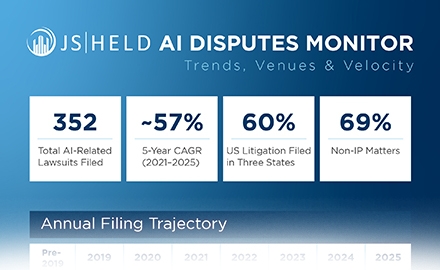
AI-related litigation has surged at a 56.5% five-year compounded annual growth rate, with 93% of cases filed in the United States and significant concentrations in California, New York, and Illinois. From generative AI copyright disputes to predictive analytics implications for criminal justice, the complexity and volume of AI litigation demand specialized intelligence.
The J.S. Held AI Disputes Monitor is a comprehensive dashboard resource designed for litigators who need to stay ahead of this rapidly evolving area of law. The Monitor tracks case developments across AI technology categories, market segments, and jurisdictions, drawing on data from independent, publicly accessible third-party sources, and combining it with expert analysis from our team to deliver actionable intelligence you can use to advise clients, assess risk, and anticipate emerging trends.

Artificial Intelligence (AI) continues to make groundbreaking advances, with more companies and organizations investing substantial research and development into this new technology in ways that will revolutionize countless industries and aspects of daily life. Consequently, safeguarding intellectual property through the use of patents, copyrights, and trade secrets is critical for innovation and commercialization.
In the 2023 Artificial Intelligence (AI) Industry Report, experts with Ocean Tomo, a part of J.S. Held, detail the present state of the AI industry as well as its imminent future.

In the 2025 J.S. Held Global Risk Report, we provide insight into artificial intelligence (AI), data, and digital regulation risks and opportunities, including:

The internet is overflowing with data, which has major implications for companies, business strategy, and litigation. Data sources can range from a video street camera, to an executive’s flight records, to Twitter and other social media.
The challenge of analyzing, filtering, and visualizing the vast amount and variety of all this information and putting it into usable form is being met with new technologies. When it comes to litigation, identifying and acting on key documents, email, or texts that have a significant impact on the legal strategy of a matter requires an efficient and detailed document review.
In this podcast interview at Legalweek 2023 with George Socha, Senior Vice President at Reveal-Brainspace, Mike Gaudet, Managing Director in J.S. Held’s Digital Investigations & Discovery group, discusses how to navigate the exponential growth of data sources through the use of new technologies that streamline the collection and analysis of information.

AI washing is the practice of exaggerating artificial intelligence (AI) capabilities, and it has become the AI era’s greenwashing. It’s now a legal risk. In this 90-second briefing, J.S. Held’s Chief Intellectual Property Officer explains:
If your organization uses AI, understanding the risk is critical, as false AI claims can lead to lawsuits, fines, and reputational damage.
Intangible assets now command 90% of S&P 500 market value making the Chief Intellectual Property Officer (CIPO) an essential role for companies....
A guide to conducting forensic accounting and digital investigations, outlining critical steps, common pitfalls, and real-world case examples....
In this Q&A conversation, Healthcare expert Magi Curtis, and Intellectual Property experts Noor Al-Banna and Gregory Campanella, discuss how healthcare and life sciences companies should be managing and leveraging their IP....