Lenders, investors, and financial stakeholders should read this article to:
Assess risk in a structurally changing market by understanding how declining demand, excess supply, tighter capital, tariffs, and inventory pressures affect cash flow, collateral quality, and asset values.
Identify strategies to preserve and recover value through liquidity stabilization, inventory optimization, debt restructuring, receivership, bankruptcy, and other structured solutions.
Evaluate opportunities with greater precision by separating the economics of vineyard land, winery operations, brands, and inventory when considering financing decisions, distressed acquisitions, recapitalizations, or exits.
Vineyard and winery owners, operators, and their advisors should read this article to:
Recognize the operational and financial pressures reshaping the industry and how those factors may affect liquidity and long-term viability.
Make more informed asset-level decisions by evaluating brand strength, vineyard economics, winery operations, inventory, and land value separately to determine what should be stabilized, repositioned, sold, or exited.
Act earlier to preserve enterprise value by considering practical tools such as cash flow forecasting, inventory optimization, cost controls, debt restructuring, recapitalization, receivership, bankruptcy, or an out-of-court wind-down.
Mike draws on decades of restructuring and turnaround experience to provide insight into the challenges facing distressed vineyard and winery assets in a rapidly changing market. He explores the financial and operational decisions that can help stakeholders stabilize businesses, preserve asset value, and position themselves for an evolving industry landscape.
Executive Summary
The wine industry’s current downturn is creating new valuation, liquidity, and restructuring challenges for vineyard and winery assets. Excess grape supply, tariffs, and wildfire-related smoke taint are affecting how vineyard owners, lenders, and investors assess vineyard land, winery operations, and wine inventory. The core issue is no longer determining whether market conditions will improve, but understanding which assets continue to support value, which require stabilization, and which may need to be restructured, sold, or wound down. This article frames those decisions around the practical realities of handling distressed vineyard and winery assets, including liquidity, inventory management, asset-level valuation, and recovery strategy, for an industry landscape that may look materially different in the years ahead.
Introduction
The wine industry is undergoing a structural reset fueled by oversupply, reduced consumption, and tighter capital conditions. While wine has often been shaped by cycles of oversupply and softer demand, today’s imbalance continues to unfold alongside broader changes in consumer behavior, distribution, trade policy, and vineyard economics.
The overall wine market value has benefited from premiumization — the wine industry’s attempt to market higher-quality, more expensive wines to consumers — and wine tourism opportunities. Yet, factors such as inventory overhang, vineyard removals, tighter lending conditions, tariff-related uncertainty, wildfire-related damage, and recent winery bankruptcies indicate that many operators are facing pressure tied to longer-term market realignment.
As inventory becomes more expensive to carry, grape supply remains out of balance, and lender scrutiny increases, stakeholders must closely evaluate brand viability, collateral quality, cash flow trajectory, and long-term land value separately, even when those assets are held together. Successful outcomes depend on early, disciplined action.
Drawing on experience in restructuring, receivership, valuation, and distressed asset advisory, this article examines the strategic decisions facing vineyard owners, winery operators, lenders, and investors. It outlines how stakeholders can evaluate liquidity, working capital, inventory management, stakeholder alignment, and asset-level valuation, as well as restructuring options such as recapitalizations, receiverships, Chapter 11 bankruptcy proceedings, Article 9 sales, and out-of-court restructurings. This is part one of a two-part examination of the wine industry. Part two in WineBusiness Monthly will analyze the structural adjustment the US wine industry is undergoing and offer a practical guide to three possible scenarios that vineyard owners, wineries, lenders, and investors can anticipate and plan for.
A Structural Reset, not a Cyclical Dip
The global wine industry is operating in a changed market. Consumption patterns are shifting, supply exceeds demand, and access to capital has become constrained. While the industry has experienced challenging supply-demand cycles before, current conditions are driving a deeper reassessment of how vineyard, winery, and brand assets are structured, financed, and valued.
So far in 2026, these pressures have significantly impacted some wineries. In the first half of 2026, several wineries were in distress. The Robledo Family Winery in Sonoma County filed for Chapter 11 bankruptcy in April, while the Aloria Vineyards and the Sran Vineyards both filed for bankruptcy in February. Additionally, Pacific Rim Winemakers in Washington state also filed for bankruptcy protection in April. For owners, lenders, and investors, the key question is: How should owners, lenders, and investors evaluate distressed vineyard, winery, and brand assets as wine industry economics change?
In this environment, stakeholders need strategic pathways to stabilize operations, preserve value, and align outcomes across ownership, lending, and investment groups. That analysis requires more than a broad view of market conditions; it requires asset-level attention to liquidity, collateral, operations, and long-term value.
The New Economics Behind Wineries
Where the Market Stands Today
Widespread disruptions to vineyards and wineries have become more pronounced in recent years and continue to ripple through the industry. Supply and demand remain out of balance as consumers increasingly cut back their consumption, capital constraints persist, and distribution channels struggle to evolve.
Operators accustomed to tried-and-true processes developed over decades are being forced to adapt quickly to survive these structural changes.
Demand: Structural Pressure
Wine demand in the United States and worldwide has been under sustained pressure for several years. The global consumption of wine has dropped 2.7% in 2025 compared to 2024, according to the International Organisation of Vine and Wine (OIV). In its State of the World Wine Sector in 2025 report, the OIV stated that “three major markets have played a particularly important role in driving the global decline. China has recorded the largest contraction… France continues a long-term downward trend that began several decades ago, and the USA has recently experienced a marked slowdown in consumption.” The report also stated, “nine of the world’s ten largest wine markets recorded lower consumption volumes compared with 2024.” Noting that the US is the largest wine market in the world, the report cited lower consumption to a “combination of demographic, behavioral, and economic factors.”
While worldwide consumption may have fallen, total US consumer spending on wine in 2025 grew 3% to more than USD 115 billion, and total market value was more than USD 40 billion larger than in 2018, according to the BMO 2026 Wine Market Report. Yet, the report also highlighted a persistent downward trend: total market volume in 2025 was 4% lower than in 2024 and 12% lower than in 2018.
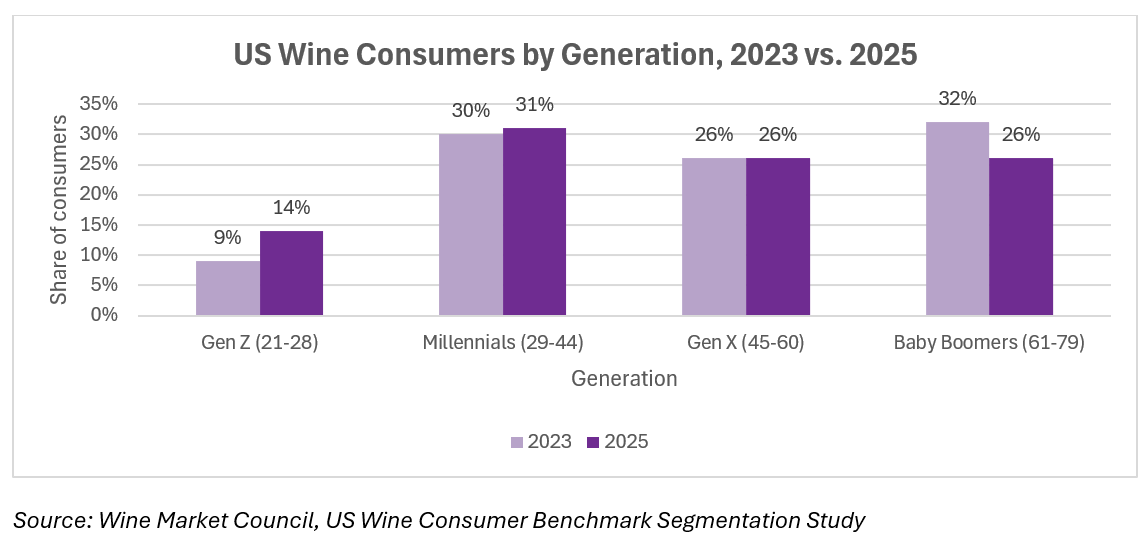
Demographic changes are affecting the wine industry as well. Younger consumers are approaching alcohol differently, with increased moderation and broader beverage choices. However, the Baby Boomer generation has seen a significant decline in demand for wine. See the chart below.
Although premiumization has supported overall revenue, it has not reversed the underlying trend. As a result, direct-to-consumer channels are facing higher costs amidst softer demand, while wholesale distribution performance has become less predictable, particularly for smaller and mid-sized producers.
Wineries are coping, in part, by promoting wine tourism. Despite recent wildfires in Europe near vineyards and the resulting evacuations, the global wine tourism market size is projected to grow from USD 64.6 billion in 2026 to USD 106.7 billion by 2030, according to Grand View Research’s Wine Tourism Market Summary. The wine tourism market in the US is expected to grow at a compound annual growth rate of 14% from 2024 to 2030, the report stated.
Supply: Adjustment in Progress
At the same time, supply-side corrections are underway but incomplete.
Producers continue to manage a significant inventory overhang relative to current sales. Smaller harvests, vineyard idling and destruction from wildfires and other severe weather events, and fruit drop have reduced output, but supply has not yet aligned with demand.
The number of US wineries at the start of 2026 declined by 3% to 11,107, or 4% less than in 2024, according to WineBusiness Analytics. The number of wineries in California fell 2% to 4,646. Meanwhile, Texas, which had seen significant winery growth in recent years, saw its numbers dip by 3% to 521. While the number of US wineries grew at an average annual rate of 4% from 2012 through 2022, the rate of growth began to slow in 2023 and peaked in 2024 at 11,584.
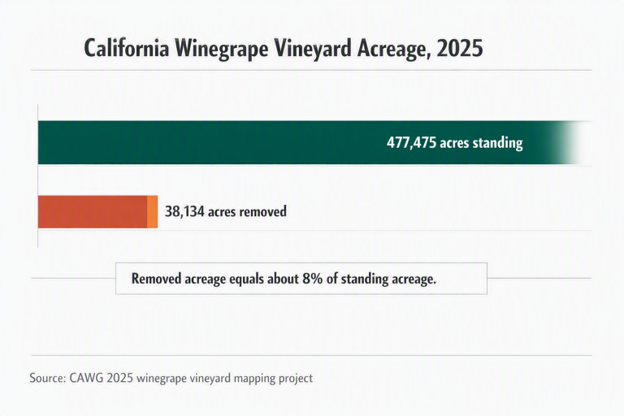
In the US, vineyard removals have increased, with thousands of acres taken out of production from 2024 to 2025. With California representing 80% of the US wine market, the California Association of Winegrape Growers (CAWG) has said that its growers have suffered years of decreasing crush volumes, contract cancellations, vineyard removals, and “historically high levels of unharvested fruit.”
Further reductions are expected as growers respond to market conditions. Given the timeline for vineyards to achieve robust production, adapting crops to demand is a slow process.
Capital and Distribution: Liquidity Pressures
Capital conditions are amplifying challenges.
Higher interest rates have increased the cost of carrying inventory and servicing debt. Many operators are managing through tight liquidity cycles, in which working capital, harvest timing, and inventory turnover are closely linked. Declining inventory values threaten loan covenants, with many wineries already in default with their lenders.
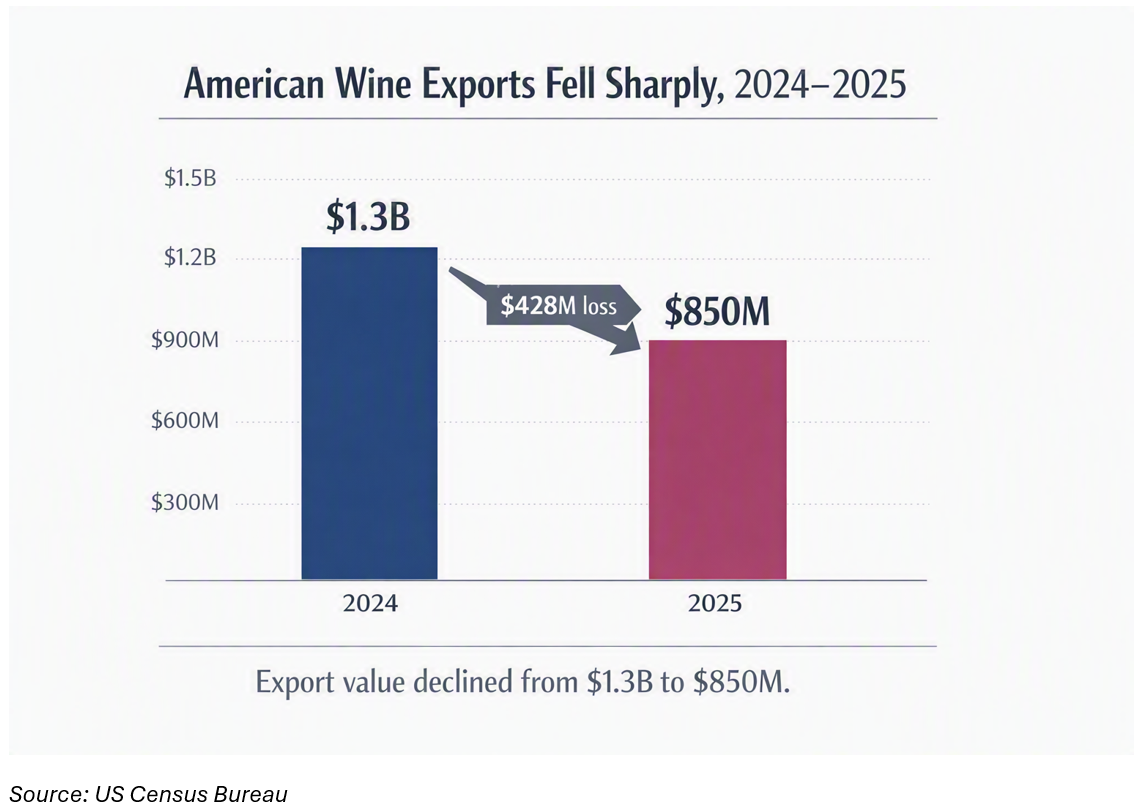
Distribution instability due to tariffs compounds uncertainty in revenue predictability. The Trump Administration’s tariffs were a factor in the decline in the global wine trade in 2025. One result was a Canadian ban on American alcohol sales.
Trade uncertainty also affected import numbers, which softened as well. The US market saw its wine import value decline 11.6% from 2024, even as the country remained the world’s largest wine importer by value, according to OIV. These factors are accelerating decisions. Situations that once allowed gradual adjustment are reaching liquidity-driven inflection points, requiring faster alignment among stakeholders.
The Restructuring Toolkit: Preserving Enterprise Value
When a company is under financial pressure, its survival and next steps depend on thoughtful, informed evaluations of its liquidity, asset quality, capital structure, and stakeholder alignment.
Turnaround and Operational Stabilization
A business cannot proceed without operating capital. Thus, the first priority for a distressed business is stabilizing liquidity and identifying future shortfalls.
Key actions include:
Short-term cash flow forecasting
Working capital and inventory optimization
Cost reduction and overhead control
Adjustments to sales and distribution strategies
Deployment of interim leadership, including Chief Restructuring Officer (CRO) or CFO roles
These steps restore visibility into cash flow and create a basis for further action.
For instance, consider an ownership group of wine importers operating multiple warehouses that discovered operational and governance deficiencies. These included a lack of stock control procedures, resulting in large-scale inventory discrepancies.
Step One –Financial Visibility and Compliance: Focus on restoring financial control and regulatory compliance by recruiting full-time accounting staff and implementing a formal accounting system to generate reliable financial information. Establish constructive dialogue with relevant tax and regulatory authorities and bring all overdue statutory filings and returns fully up to date.
Step Two – Operational Control and Asset Protection: Introduce robust stock control procedures, including monthly physical stock counts and reconciliation processes to materially reduce inventory discrepancies and mitigate ongoing stock loss and margin leakage.
Step Three – Governance and Leadership Structure: Implement a comprehensive corporate governance framework, including monthly board meetings and committees focused on financial oversight and business management. Strengthen leadership by appointing a new general manager and an independent director.
Recapitalization Strategies
When operational changes fail to produce sufficient cash flow, capital restructuring is required.
Options include:
Debt refinancing or restructuring
Covenant renegotiation
Introduction of new equity or strategic partners
Monetization of assets through sale-leaseback structures, particularly involving vineyard land
Separating land ownership from operations can improve liquidity while maintaining supply continuity
Structured Transactions and Fiduciary Processes
More complex situations may require formal restructuring or court-supervised processes. Common methods include:
Negotiated out-of-court restructurings
Assignment for the benefit of creditors
Article 9 sales
Receivership, where a court-appointed fiduciary preserves and maximizes asset value
Chapter 11 or Chapter 12 proceedings
Consider the case of a large winery that filed for Chapter 11 bankruptcy protection. A CRO can assess the remaining assets of the winery’s estates and conduct a restructuring while maximizing creditor recovery.
In doing so, the CRO can perform the following actions:
Maximize Receivables Recovery: Identify outstanding accounts receivable, issue demand letters to nonresponsive customers, and negotiate payment terms to secure full or partial collections.
Unlock Hidden Value: Discover additional recovery opportunities beyond receivables - such as canceling business licenses, liquor licenses, insurance policies, and bonds—to improve stakeholders’ returns.
Control Costs: Negotiate rates and fee caps with third-party service providers to ensure budget adherence and minimize overages within the court-approved framework.
Managing an Organized Sale Process: Identifying resources to support a robust and thorough marketing and sale process to maximize the value of the assets.
Winding Down Operations: Facilitate the complex process of terminating the debtor’s obligations efficiently and optimizing recoveries.
Whether it is an out-of-court restructuring, a receivership, or a bankruptcy, these approaches provide structure and transparency while aligning stakeholders’ interests around value preservation.
Different Decision Frameworks for Stakeholders
Effective decision-making requires alignment around liquidity, asset value, and stakeholder objectives.
Owners
Owners must evaluate:
Brand viability
Vineyard economics
Operational sustainability
Options include restructuring, repositioning, or partial or full exit.
Lenders
Lenders assess:
Collateral quality
Cash flow trajectory
Exit timing
Actions may include restructuring support, enforcement, or appointment of a receiver to stabilize operations and preserve value.
Investors
Investors evaluate:
Distressed acquisition opportunities
Recapitalization strategies
Long-term land value
Structured transactions often provide entry points with clearer risk profiles.
Conclusion: Acting in a Changed Market
The wine industry’s current challenges reflect more than a temporary market correction; they signal a changed operating environment that requires owners, lenders, and investors to act with greater discipline, transparency, collaboration, speed, and precision. As demand patterns shift, supply continues to rebalance, and capital becomes more selective, stakeholders will need to evaluate vineyard, winery, and brand assets on their individual merits, stabilize liquidity early, and pursue restructuring, transaction, or wind-down strategies that preserve value.
As a result, for owners, lenders, and investors, the question is not simply, “Is the wine industry in trouble?” It is how that pressure should change the evaluation of a specific distressed winery and related assets. Those who address distress early, using clear financial insights, stakeholder alignment, and a realistic view of asset economics, will be best positioned to avoid pitfalls and capitalize on the opportunities presented by the evolving wine industry in the US and globally.
Acknowledgments
J.S. Held would like to thank Mike Bergthold, CTP, for providing insights and expertise that greatly assisted this research.
Mike Bergthold, CTP, is a Senior Managing Director in J.S. Held’s Strategic Advisory Group. He is a highly experienced turnaround executive bringing more than 30 years of experience advising public and private companies on strategy, finance, and accounting. He has served as a chief restructuring officer (CRO), financial advisor, interim executive, or strategic board member for companies in financial distress or transition. As an interim CEO, CFO, president, or director of companies in transition, Mike skillfully guides management teams and stakeholders through strategic planning, budgeting and forecasting, complex negotiations, and recapitalizations. Mike is a Certified Treasury Professional (CTP) with industry experience in agriculture, diagnostic laboratory, manufacturing, professional services, real estate, transportation, and IT services.
Transparency Statement: Artificial intelligence tools were used to support the development of this thought leadership content, which could include research support, information synthesis, and editorial refinement. The analysis, insights, perspectives, and conclusions presented are those of the author(s) and reflect their professional expertise and judgment. The content was reviewed by the author(s) for accuracy, relevance, and consistency with the source materials. Artificial intelligence tools did not independently determine the content's conclusions or recommendations.
When wildfires hit wine country, losses can involve smoke taint and other problems, turning a wine inventory claim into a complex valuation challenge....