Winery executives and commercial leaders, wine producers, distributors, and retailers, consumer product and beverage industry decision-makers, marketing, customer experience, and brand strategy professionals, and others should read this article to learn more about:
Why the wine industry's slowdown is also a customer experience problem, and why pricing, promotions, distribution, and product innovation alone may not resolve it.
How user experience (UX) research applies well beyond digital products to physical shelf items such as wine.
How similar consumer purchases can reflect very different motivations.
How friction, rather than disinterest, often blocks a consumer’s next purchase.
How UX research turns customer insight into evidence-based action.
How the "one more bottle" opportunity can be supported by incremental improvement strategies.
Michael draws on more than 30 years of user experience research to show how understanding customer motivations, decision-making barriers, and confidence gaps can help the wine industry, from producers to the checkout aisle, create experiences that encourage consumers to purchase. He highlights how UX methodologies translate customer insights into practical strategies that reduce friction and strengthen engagement.
Executive Summary
The wine industry is facing a difficult reality. Consumer demand has softened, price sensitivity remains elevated, competition for shelf space has intensified, and many wineries are struggling to regain the momentum they enjoyed prior to 2020. The industry's response has leaned heavily on a familiar set of levers: pricing, promotions, distribution, and product innovation. Those levers matter, and they account for various aspects of consumers in the marketplace; however, relying on these alone may leave a crucial factor influencing purchase behavior largely unexamined: customer experience.
The challenge is not simply that consumers no longer appreciate wine. Rather, the contexts, motivations, and experiences surrounding wine consumption have evolved. Consumers are making different choices based on changing lifestyles, economic pressures, health considerations, social norms, and purchasing environments.
This creates an opportunity. By applying user experience (UX) methodologies, wine producers, distributors, and retailers can gain a deeper understanding of customer motivations, sentiment, and behavior from in-store, at-home, and online customer engagements, and identify practical opportunities to encourage the purchase of "one more bottle."
The goal is not to convince consumers to buy more wine than they want. The goal is to remove friction, improve relevance, increase confidence, and create experiences that make wine a more natural and rewarding choice within consumers' lives.
The Wine Industry's Challenge Is Also an Experience Challenge
Many industry discussions focus on declining consumption trends, changing demographics, and increased competition from other beverage categories. These factors are real and important, and they point naturally toward pricing, promotions, distribution, and product innovation responses. What they do not explain is how a consumer decides, in the moment, whether to buy a bottle at all.
Consumers rarely experience market dynamics as the industry does. Consumers experience:
Busy schedules
Budget constraints
Health and wellness goals
Social occasions
Family responsibilities
Decision fatigue
Uncertainty about wine selection
Limited confidence in wine knowledge
Date night and “It’s finally Friday” scenarios
When a consumer stands in front of a retail shelf, scrolls through an online store, talks with a significant other about why they want to purchase a particular bottle, or considers ordering a bottle with dinner, they are not thinking about industry forecasts. They are evaluating whether wine fits their current needs, preferences, physical and mental state, and circumstances. Their familiarity with wine selection is also a factor and plays an important role, though that is not the focus of this article.
Understanding the decision-making process is where UX research becomes valuable in connecting the user’s cart to a company’s business objectives. It treats experience as a growth lever in its own right, alongside pricing, promotions, distribution, and product innovation, rather than as a downstream consequence of them.
What User Experience Means in the Wine Industry
User experience is often associated with websites, software, and technology products. In reality, UX is the study of how people interact with products, services, environments, and systems to accomplish goals.
For wine companies, the customer journey extends far beyond the bottle itself. Consider the complete experience. “A consumer will…”:
Decide they want a beverage.
Evaluate wine against other options.
Choose a retailer or restaurant.
Navigate shelves, menus, or websites.
Interpret labels and descriptions.
Engage their significant other in budget limits and brand preferences.
Evaluate pricing.
Make a purchase decision.
Consume the product.
Decide whether to purchase again or recommend it.
At each step of this experience, customers may encounter opportunities, barriers, frustrations, and motivations that influence their journey and purchasing behavior.
UX methods help organizations identify those moments and optimize them for the consumer and the organization.
Understanding the “Why” Behind Purchases
Consumers may purchase the same bottle for entirely distinct reasons. One may be celebrating an anniversary and want to make it a special night, while another may just be looking to unwind after a long work week. Another may be hosting a party, while yet another just wants to try something new or premium with dinner tonight. The purchase data may look much the same. Understanding the variety of motivations behind purchases can give us a better glimpse into how different information and sales interactions influence a customer’s decision to reach for a bottle.
Organizations that understand these motivations can tailor their marketing campaigns, packaging, retail experience, or engagement programs to fit the specific needs of different customers. When done well, the result is likely to be increased relevance and stronger customer connections.
Finding Friction That Prevents the Next Purchase
A common misconception is that declining sales always reflect declining demand. Frequently, consumers encounter friction that prevents them from making a purchase. Examples include:
Selection overload. Many consumers find wine intimidating. Thousands of labels, regions, varietals, ratings, and price points can make decision-making exhausting.
Translating bottle information to taste preferences. Customers might consider new wines more often, but they must map complex flavor information on the bottle to what they like.
Lack of confidence. Customers often worry about choosing the wrong bottle for an occasion, meal, or gift, and feel a gift card is too impersonal.
Unclear value. Consumers may struggle to understand why one bottle is worth $25 while another costs $12.
Retail navigation challenges. Shelf layouts, signage, and product categorization may not align with the changing user experiences created by today’s industry and consumer challenges.
Digital experience problems. Online wine shopping experiences may prioritize inventory and features over helping customers make confident decisions.
UX research helps elicit consumer-driven data that explain the friction points and generate user-centric requirements that help drive evidence-based solutions.
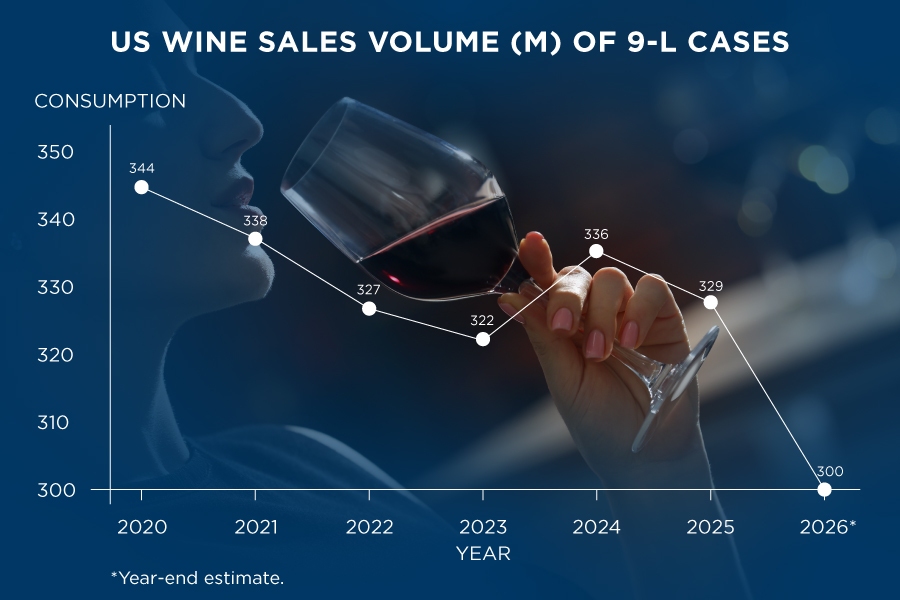
Figure 1 - US wine sales volume 2020-2026 (Source: Impact Database Project for U.S. Wine).
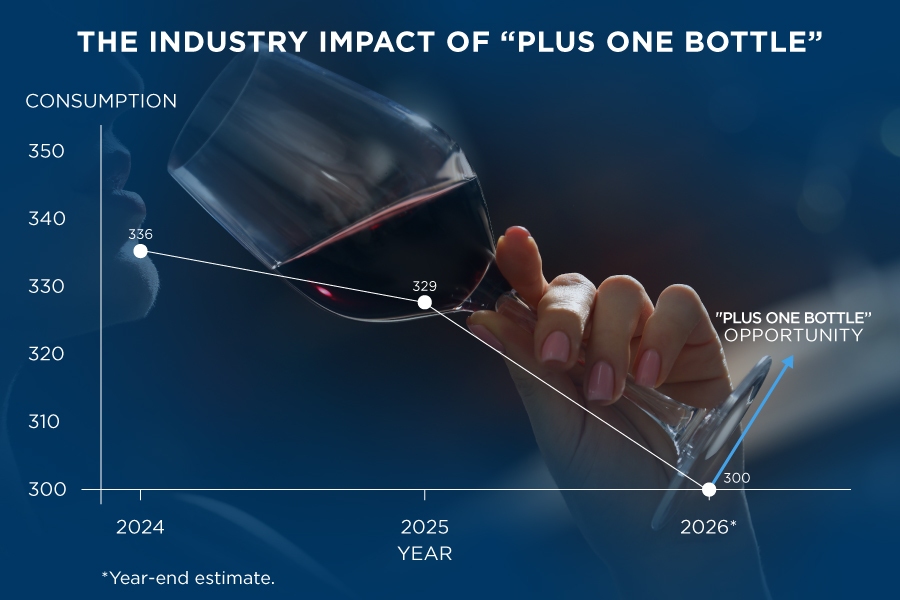
The “Plus One Bottle” Opportunity
The concept of “plus one bottle” is intentionally simple. Instead of attempting to transform consumer behavior overnight, organizations can focus on incremental improvements that increase the likelihood of purchase. Examples include:
Improving confidence. Consumers who feel confident in their selection are more likely to add an additional bottle.
Using customer voice. Using the vast array of flavor descriptors can be overly complex for many wine consumers, who want an easier way to map what they like to a small selection of wines.
Reducing decision complexity. Simplifying the choice can increase the likelihood that customers complete the purchase.
Figure 2 - Industry impact of “plus one bottle” (Source: Impact Database Project for U.S. Wine).
How UX Professionals Generate Actionable Insights
UX research is more effective when it moves beyond assumptions and uncovers the real factors influencing customer decisions. UX professionals seek to understand how consumers think, feel, and behave throughout their wine-buying journey. This may involve speaking directly with customers about their motivations, observing how they shop in retail environments, engaging customers during ideation workshops, analyzing the emotional drivers behind purchasing decisions, evaluating digital and in-store experiences, and mapping the complete customer journey from initial consideration to repeat purchase.
By examining where customers experience uncertainty, frustration, confidence, excitement, and delight, UX researchers can identify opportunities that might otherwise be overlooked. These insights help wineries, distributors, and retailers make more informed decisions about marketing, merchandising, packaging, product positioning, customer engagement, and sales strategies. The result is not simply more data, but a deeper understanding of the experiences that influence purchasing behavior and, ultimately, opportunities to encourage the purchase of one more bottle.
Conclusion
The wine industry has weathered changing consumer preferences, economic cycles, and competitive pressures before. Today's challenges, however, are different in kind as much as in degree. Consumers are weighing wine against health and wellness goals, tighter budgets, and a wider set of beverage options. They often begin the purchase online, where sites built around inventory and filters may only be addressing part of the customer’s friction points. And at the shelf they are still asked to navigate thousands of labels, largely unaided, in layouts and signage that may not have kept pace with how they now decide. Each of those pressures is also an opening to better understand customers and create experiences that support growth.
Consumer behavior is not driven solely by price or product quality, which is why the industry's traditional levers can be pulled hard and still return little. Purchasing is shaped by emotions, perceptions, motivations, confidence, convenience, and context, and those are the conditions that user experience work is designed to change.
By applying UX methodologies, wineries and wine industry partners can gain a clearer understanding of these influences and identify practical, measurable ways to strengthen customer engagement.
The future may not depend on producing dramatically different wines or different beverage choices. It may depend on delivering dramatically better experiences around it, or perhaps just substantially different ones.
And sometimes, the difference between a struggling sale and a growing business is simply helping a customer choose one more bottle.
Acknowledgments
J.S. Held would like to thank Michael DeVries for providing insights and expertise that greatly assisted this research.
More About J.S. Held’s Contributor
Michael DeVries is a Managing Scientist in J.S. Held’s Human Factors & User Experience service line. Michael has been eliciting user sentiment and product requirements for over 30 years. He has influenced products seen in the skies, on oceans and lakes, in dirt, in back pockets, on scientific benches, in bank accounts, on computers, and on cell phones. He is a co-author of patents for two companies, has designed a game table he hopes to patent, and thrives on translating user data into user requirements that lead to new opportunities, features, and ideas.
The impact of human factors research and user-centered design in medical device manufacturing, including product safety, effectiveness, and business benefits....
INDUSTRY INSIGHTS
Keep up with the latest research and announcements from our team.