Daniel applies his expertise as a chartered quantity surveyor and construction quantum expert to analyze how time affects project costs. He distinguishes time-related from task-related costs and explains how productivity, inflation, currency movements, and regulatory change influence the accurate quantification of delay impacts.
Executive Summary
Time functions as one of the most significant drivers of cost escalation in construction projects. This article explores the distinction between time-related and task-related costs, demonstrates how delays impact each category differently, and provides practical guidance for evaluating prolongation costs, productivity losses, inflationary impacts, and other financial consequences of project delay.
Introduction
“Time is the most valuable thing a man can spend…” [1] This quote was not intended for the construction industry, and yet it is apt because, whilst there are many ways of subdividing cost on a construction project (fixed costs, preliminary costs, etc.), a useful method of distinguishing them is between those that are influenced by time and those that are influenced by quantity.
Time and quantity are interrelated in construction, but only ever in a unidirectional relationship. While an increase in quantity may necessitate additional time, an extension of time does not, of itself, result in an increase in the quantity of work.
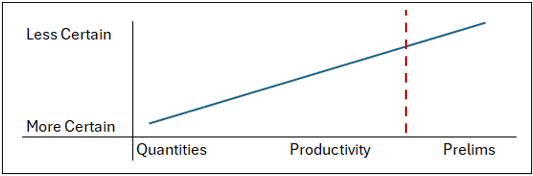
When considering these distinctions, it is useful to consider that the art of estimating is largely akin to that of a fortune teller. That is, an estimator is required to predict the future; however, within that prediction, there are levels of uncertainty as shown in the simplistic graph below:
As shown above, there are elements of the estimating process where the level of uncertainty is low. These are elements that can be measured. This is illustrated by a simple worked example of a 10km road. The required volume of wearing course can be readily determined: For a road 7.3m wide, 10km long, and with a 40mm thick wearing course, the total volume of compacted material is 2,920m.3 This is a precise quantity of material, for which the only uncertainty risk will relate to minor risk items such as wastage, defective work, and compaction [2]. However, how long the work will take to complete is a function of the size and productivity of the labour force, climatic conditions, and working restrictions.
While quantities are measurable, duration is more complex and dependent on a myriad of factors. This shows how work undertaken on site, and correspondingly the cost, will reflect a combination of time and quantity rather than a single driver. The red dividing line shown on the graph above identifies the point at which, commonly, the primary driver of cost shifts from time-related to task-related.
Time-Related Versus Task-Related
The distinction between Time-Related and Task-Related costs depends on identifying the dominant driver of the cost incurred. Firstly, it must be recognised that this varies between sites and sectors. As a result, it is not helpful to prescribe guidelines on what costs should be classified as Time-Related or Task-Related. Instead, it is essential to consider the characteristics that define each category and to apply those criteria to the costs incurred on any given site. Secondly, the test is to identify the dominant driver. That is to say, exceptions can always be identified and counter-arguments presented; however, it is the dominant driver, rather than the sole driver, that is relevant.
The test for a Time-Related cost has two parts:
Confirmation that the cost is not overly impacted by fluctuations in the quantity of work performed on site; and
The cost will increase as a result of any extended period of critical delay to the works.
A Task-Related cost is then the inverse of the above:
Confirmation that the cost is directly impacted by fluctuations in the quantity of work performed on site; and
The cost is linked to a work activity on site and would not increase if there was a delay in a different and unrelated work activity.
An example of a cost that could be either Time-Related or Task-Related, depending on the site-based criteria, is testing (e.g., testing and providing material samples).
Scenario 1 – The contract requires that for every 10m³ of material laid, a test or sample of the material needs to be taken. In this scenario, the testing will increase if the volume of work increases, and it will decrease if the volume of work decreases. This would therefore result in a Task-Related classification of this testing. This allocation of the cost is not dependent on the inclusion of the expenditure in the permanent works but rather cause of the cost. However, it is possible that a critical path delay to the laying of the material may result in a delay claim from the supplier of the testing and thus change the classification of the cost to a Time-Related cost.
Scenario 2 – The contract requires monthly sampling from a bore hole adjacent to the works for the full duration of the project. In this scenario, any critical delay to the project will result in increased sampling costs. In other words, the cost is not linked to the activities on site, and is not impacted by changes in quantities, other than through any increase in the duration of the works.
To summarise, the sampling costs in Scenario 1 would be classified as Task-Related, and in Scenario 2, they would be classified as Time-Related.
Impact of Time on Time-Related Costs
When it comes to the impact of time on a project’s overall cost, it is always most visible in the Time-Related Costs. This is because, as discussed above, the dominant driver of change in Time-Related Costs is Time. However, the profile and method of assessment vary between different classes of Time-Related costs. Below are some examples of common classes. Please note, however, this is not an exhaustive list, and the nature of the cost on any particular project may necessitate different analytical methodologies.
Site Setup
Site setup is typically referred to as a preliminary cost. This includes some of the following items:
Site fencing and hoarding
Site offices
Site welfare facilities
Labour camp accommodation
Stores
These costs all appear, prima facie, to be Time-Related. However, it is essential to look at the patterns in the data to understand the nature of the cost and to then verify recurring entries as Time-Related.
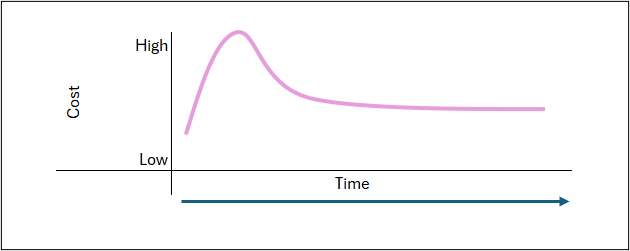
If the Site Setup cost profile looks like the graph below:
Then it is likely that the site fencing and hoarding have been purchased and installed at the start, which is depicted by the cost spike in the graph above. Given that the site fencing and hoarding were purchased, as opposed to hired, the cost of it will not continue to increase as the project progresses and is, therefore, not a Time-Related Cost. As such, the site fencing and hoarding costs, in this example, should be removed from any prolongation assessment.
The remainder of the costs appear to recur at a consistent value, as depicted by the horizontal line at the back end of the graph above, which therefore suggests that these costs are likely Time-Related Costs incurred through the hire of the site facilities. Where the cost relates to hire charges, these costs will continue to be incurred for the duration of any critical path delay to the project.
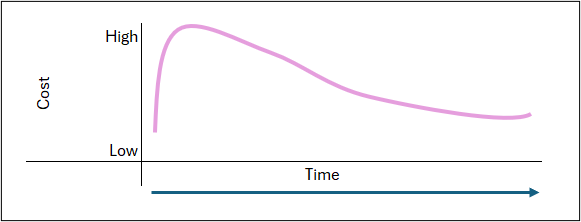
Another common cost profile, in graphical format, is shown below:
The graph above shows a high-cost profile at the outset, which then diminishes over time. This is typical where facilities have been purchased as capital expenditure and are subsequently depreciated, by either using a reducing balance methodology or by reference to periodic market valuation. In such circumstances, this supports classification as a Time-Related Cost within a prolongation assessment, but the point in time at which the cost is assessed needs to be considered in relation to when the financial loss is felt. This is because the financial loss at the outset of the depreciation curve would have been incurred in any event.
As discussed above, it is essential to consider the nature of the cost and the patterns within the data rather than applying blanket rules to assessment.
Bonds, Guarantees, and Insurance
Another category of cost to be assessed is bonds, guarantees, and insurance. These are all costs that are required for the duration of a project. As a result, any delay to the project’s completion will result in additional costs incurred under this category. However, the cost profile is often different to that of Site Setup explained in the section above.
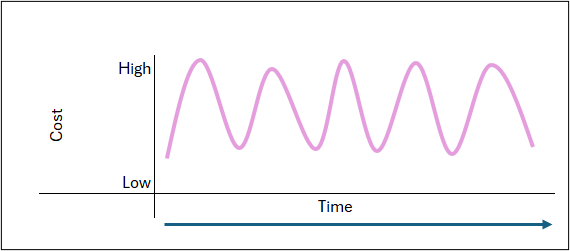
Rather than a smooth cost profile, this category of cost often exhibits a profile similar to that shown below:
The oscillating cost profile above shows peaks of high cost followed by troughs of no cost. This is because such costs are typically incurred annually, with payment made in advance of the Contractor receiving the benefit. For example, an insurance policy may be paid for on an annual basis, but its benefit is only realised in the future (during the insured period) should the Contractor need to call upon it. Therefore, when assessing the financial impact of any delay, it is necessary to first smooth the cost spikes by spreading them over the insured period to which the benefit relates. If the cost is for an annual period, this would be achieved by dividing the cost by 12 and including one-twelfth per month in the assessment. This would then allow an accurate allocation of the cost to the period to which it relates.
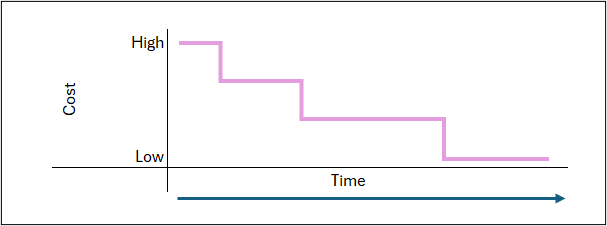
Another cost profile commonly seen under this category of cost is shown in the graph below, relating to bonds:
In the above example, there is a stepping-down of the cost throughout the project duration. This type of cost profile will be seen where a bond is linked to a diminishing value. An example is an advance payment bond, which decreases over time as the certified value of work completed increases in the interim payment certificates. The inverse of this graph can also be seen, where a bond is linked to an increasing value, for example, the Contract Sum, increasing over the project duration. Where the cost profile is not static and has these characteristics, it is essential that the correct costs are attributed to the correct periods, so that any delay periods assessed have correctly quantified costs attached.
Impact of Time on Task-Related Costs
In the above sections, I have discussed the impact of time on the assessment of Time-Related Costs, but it is also important to recognise that time also impacts the financial position of a Contractor in relation to its Task-Related Costs. The assessment of such costs, however, is fundamentally different.
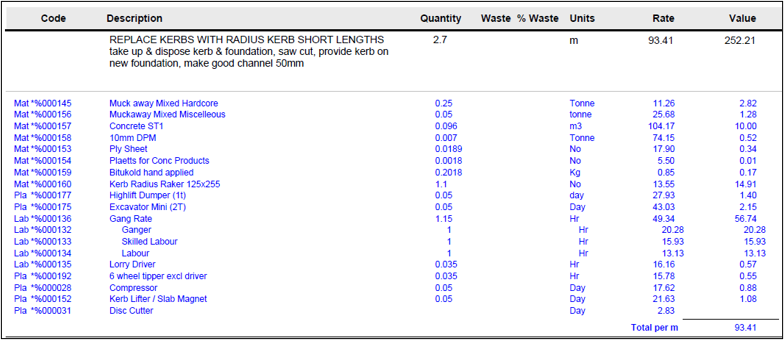
To begin, it is necessary to understand the nature of Task-Related Costs as included in tenders. The example below shows the build-up to a rate for replacing kerbs, taken from a bill of quantities. The description, quantity, and rate for the kerbing works are set out in the top line, with the rate breakdown set out below.:
As can be seen above, the rate is predominantly a function of two factors [3]:
Rate of production items; and
Quantity of materials.
Both factors are impacted differently by time and are considered below.
Productivity
Productivity is a measure of how much effort is required for a given output. For example, how many labour hours are required to replace a meter of kerbs. In the example above, there is a total allowance of 1.15 hours for a gang per meter.
If there is a loss of productivity, more time will be required to complete the desired one meter of kerbing. This can manifest in one of two ways:
The allocated labour took additional time to complete the task; or
Additional labour was allocated to the task, resulting in increased labour input without extending the overall duration.
In both scenarios, the Contractor experiences a loss when compared to the tender allowance.
In scenario one, the Contractor will likely incur additional Time-Related Costs, if the task was on the critical path. In scenario two, however, the Contractor will only incur the additional labour costs in completing the task (i.e., disruption costs) and will not incur any associated Time-Related Costs.
For this reason, where the Contractor is responsible for a loss of productivity (i.e., disruption), an increase in resources may be preferable to incurring disruption and prolongation losses across the site. However, this must be tempered by the old adage that “adding more cooks does not make the water boil faster”. There are some tasks for which increasing resources will increase cost without any appreciable improvement in programme delay.
Therefore, in relation to the productive Task-Related Costs, the impact of time is both complex and often interrelated.
Inflation
In respect of the measured works (i.e., items measured on a quantity basis), time does not solely impact productivity; it can also directly impact the prices of the items. This is commonly felt either through inflationary pressures or foreign exchange rate movements. There are two common scenarios that arise in connection with the above macroeconomic cost drivers:
Construction procurement is rarely as quick as a client would like; and
The construction industry is ever increasingly reliant on global supply chains (even where it is not immediately visible).
The first scenario is that there may be a considerable period between tendering (which is itself often a protracted process) and the point at which the cost is incurred. While the risk of changes in the price of commodities, both between tender and commencement and during the project, may be borne by the Contractor, this risk typically transfers to the Employer in the event of a delay for which the Employer is liable.
Likewise, even where the risk is borne by the Employer through the use of a price adjustment formula, delays to the project for which the Employer is liable may expose the Employer to additional inflationary risks arising from global economic shock events, such as the COVID-19 pandemic.
The second scenario relates to currency exchange rate risk, whether arising from the procurement of materials or where the contract provides for payment in multiple currencies. In recent years, currency markets have experienced significant volatility. This is particularly relevant where the currency of payment differs from that held by the Contractor or its parent company. Such exchange rate movements can result in significant losses or windfalls for either contracting party. It is therefore essential that appropriate consideration is given to this risk during the tendering process.
Changes in Law
The final temporal factor considered in this paper is that change is inevitable. As with death and taxes, this is an unavoidable and universal fact. For construction projects, this is often experienced through the introduction of new laws and regulations. In practice, such changes rarely result in a reduction in construction costs. Instead, they typically lead to an initial spike in costs, as the industry adjusts to the new norm, before dropping back to an elevated baseline. These changes may include amendments to government-mandated leave provisions (e.g., paternity and maternity leave) or regulatory changes affecting materials, such as waste material management requirements, or restrictions relating to carbon-emitting materials.
In all such cases, it is important that the allocation of risk is clearly addressed within the contract, recognising that the Employer may not be able to contract out of such risk where it arises as a consequence of an Employer liable delay event.
Conclusion
Time is expensive and one of the most significant and common drivers of cost escalation on construction projects. It is therefore recommended that, at the commencement of any construction project, all parties within the supply chain ensure that time, productivity, and change are actively and contemporaneously monitored, recorded, and witnessed.
The effects of time are far more reliably witnessed (and recorded) in the moment than reconstructed retrospectively, where it is often like looking through an old pair of binoculars that is scratched, covered in dirt, and with only one working lens.
Acknowledgments
J.S. Held thanks Daniel Miles for providing insight and expertise that greatly assisted this research.
Daniel Miles, MSc, MRICS, MCIArb, Hon FIAT, joined J.S. Held’s Construction Advisory practice as a Senior Managing Director in April of 2023 as part of J.S. Held’s acquisition of Aquila Forensics. He is an experienced chartered quantity surveyor and testifying expert witness with more than 15 years of experience working on high-value, complex disputes. Daniel has given evidence on multiple occasions in various international arbitrations. He specializes in the provision of quantum advice and opinion in mediation, adjudication, arbitration, and litigation.
Daniel lectures at both Stuttgart University and Derby University on contract administration and assessment of quantum and delays in disputes in a number of courses. He also provides training for firms on the commercial management of contracts under all significant contract forms.
[1] Philosophical observation attributed to the ancient Greek philosopher Theophrastus.
[2] It is also possible that risk items could include regulating allowances or other factors. However, for the purposes of this example, I have provided only a limited list of simple risks.
[3] A rate will often contain additional items including, risk, profit, overhead and potentially site preliminaries. However, for the purposes of this paper a simplified version is used for example purposes only.
Transparency Statement: Artificial intelligence tools were used to support the development of this thought leadership content, including research support, information synthesis, and editorial refinement. The analysis, insights, perspectives, and conclusions presented are those of the author(s) and reflect their professional expertise and judgment. The content was reviewed by the author(s) for accuracy, relevance, and consistency with the source materials. Artificial intelligence tools did not independently determine the content's conclusions or recommendations.
Construction defect claims and cases are scenarios wherein physical loss or damage is claimed to be related to defective building elements that will require repair or replacement. Typical defect claims and cases will involve exterior...
Learn about the significance of project monitors in the construction industry. Understand their role, daily tasks, and impact on ensuring accuracy, value, and timeliness toward project completion....