How selective re-globalization and geopolitical risk are reshaping business strategy and driving enterprise value protection.
Publication Date: April 16, 2026
Business Executives should read this article to:
Understand how geopolitical fragmentation, trade policy shifts, and regionalization are reshaping global supply chains, capital flows, and business continuity risks.
Learn how to strengthen operational and supply chain resilience through approaches like nearshoring, dual sourcing, and targeted inventory strategies.
Recognize the importance of integrating geopolitical risk, regulatory divergence, and policy uncertainty into strategic planning and governance.
Consider how to align capital allocation and sourcing decisions with emerging regional blocs and evolving trade dynamics.
Explore a structured framework for evaluating exposure, enhancing resilience, and positioning for competitive advantage in a fragmented global economy.
Investors and Capital Providers should read this article to:
Evaluate how political risk, trade exposure, and geographic concentration are influencing investment decisions and portfolio strategies.
Recognize jurisdictions and sectors that are increasingly favored for their stable regulatory environments and resilient infrastructure.
Understand the implications of sovereign and policy risk on underwriting, valuation, and capital allocation.
Recognize the need for deliberate hedging of tariffs, currency, and commodity exposure in a fragmented global economy.
Gain awareness of how global debt levels and geopolitical shocks are increasing financial market vulnerability.
Expert Voices
Brian Gleason Brian draws on nearly three decades of operational, financial, and restructuring expertise to explore how tariffs, regionalization, and geopolitical fragmentation reshape organizational risk and performance. Drawing upon his expertise guiding companies through periods of systemic disruption, he outlines practical strategies for building resilience, optimizing capital planning, and safeguarding enterprise value in today’s evolving global trade landscape.
Executive Summary
Uncertainty is the defining feature of 2026, reshaping globalization rather than ending it. As tariffs, export controls, geopolitical fragmentation, and regional conflicts disrupt long-standing assumptions about trade and supply chains, a more selective form of re-globalization is emerging across trusted partners and regional blocs. These developments are changing risk profiles for both capital providers and mid-market companies, with implications that extend from operational resilience and supply chain strategy to capital allocation and long-term value creation. Capital providers are increasingly required to weigh political risk, trade exposure, and geographic concentration in investment and portfolio decisions, while mid-market companies face heightened pressure to understand how trade policy shifts, regulatory divergence, and supply-chain dependencies may affect performance or business continuity. Noting J.S. Held’s integrated expertise across geopolitical risk, supply chains, financial analysis, and insurance advisory, this article details practical considerations for business leaders seeking to manage volatility, protect value, and position their organizations for competitive advantage in a fragmented global economy. The central strategic risk in 2026 is not whether globalization retreats or advances, but whether leadership teams misprice geopolitical risk by treating fragmentation as cyclical rather than structural.
Risks, Opportunities, and What Leaders Should Do Next
Business leaders are navigating a world where old assumptions about integrated supply chains, stable trade rules, and inexpensive capital no longer hold. Tariffs, export controls, sanctions, conflicts, and regulatory divergence have injected volatility into cross-border flows of goods, services, capital, data, and people.
Yet alongside de‑globalization, a form of re‑globalization is taking shape as selective integration across trusted partners and regional blocs. This trend, noted by the World Economic Forum, is most prominent in technology, services, and critical minerals value chains. According to the United Nations Trade & Development agency, global trade rose to record levels in recent years, hitting $35 trillion in 2025, and China alone reported that its 2025 accumulated trade surplus reached $1.08 trillion through November 2025.
Despite policy uncertainty and geopolitical friction, the global economy has shown moderate resilience, with Fitch Ratings’ March 2026 Global Economic Outlook projecting a slight slowdown in growth to 2.6% in 2026 from 2.7% in 2025.
The IMF also recently noted that the US-Israeli conflict with Iran has led to trade and economic disruptions as well as spikes in energy prices and financial market fluctuations. “The situation remains highly fluid and adds to an already uncertain global economic environment,” the IMF said. Furthermore, the risk backdrop is increasingly shaped by geoeconomic confrontation, which the World Economic Forum ranks as the top global risk for 2026.
For executives, this means higher planning-error risk, compressed decision windows, and greater dispersion of outcomes. Success will favor organizations that strengthen resilience without sacrificing competitiveness.
What Changed in 2025
Trade Policy Whiplash
In 2025, tariff announcements and temporary rollbacks produced an unusual pattern. Firms frontloaded trade to get ahead of potential hikes, while also reconfiguring suppliers to reduce exposure to policy shocks. The IMF notes that while effective tariff rates temporarily moderated midyear, downside risks from renewed escalation remain material. The result was not just volatility, but the IMF also notes a growing disconnect between trade policy timelines and corporate planning cycles. There remains the question of whether the full impact of the 2025 tariffs has hit consumers fully. Finally, the determination that the 2025 tariff spike was unconstitutional, the prospect of refunds, and how, when, and to whom they will be made, create further planning uncertainty.
Fragmentation and Regionalization
The global system is reorganizing around competing regulatory and political spheres, rather than converging around common rules. Bilateral and mini-lateral deals are proliferating; export controls on semiconductors and dual-use technologies are tightening; and standards are diverging across regions. The World Economic Forum describes this environment as an “age of competition” in which multilateral coordination is under strain.
Supply Chains, From Efficient to Resilient
Some forward-thinking companies have pivoted from pure cost efficiency to resilience optimization, including near‑shoring, friend-shoring, dual sourcing, and higher safety stocks. That shift is already underway. Many companies have confirmed plans to alter their supply chains over the next three to five years, while increasingly viewing technology investment, particularly AI, as a key enabler. However, according to a 2025 CNBC Supply Chain Survey, the cost of relocating supply chains to the United States and the challenge of finding skilled labor are the biggest problems for companies seeking to relocate their supply chains. The shift toward resilience is not a rejection of efficiency, but a repricing of it. In fragmented markets, supply chains optimized solely for the lowest unit cost often embed hidden risk. That exposure only becomes visible during policy shocks, sanctions, or logistics disruptions. Resilient supply chains increasingly function as financial instruments, trading modest cost premiums for materially lower volatility in earnings, delivery, and insurability.
Projected Growth Clashes with Political Uncertainty in 2026
Growth and Inflation Baseline
The IMF’s baseline outlook calls for 3.1% global growth and further disinflation in 2026. The World Bank expects some of the 2025 trade pull forward to fade in 2026, even as easier financial conditions and fiscal measures cushion the slowdown. This outlook is expected to shape global growth in 2026 and beyond in the following ways:
Advanced economies: slower growth as higher costs, tariffs, energy, and compliance weigh on activity.
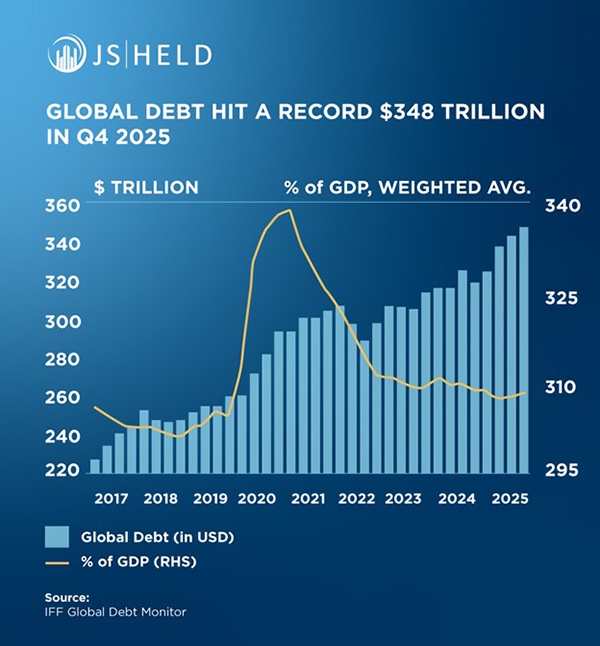
Emerging markets: continued divergence. India remains a relatively bright spot, and China manages structural transitions involving property and local debt amid external pressure, according to the IMF.Inflation: gradual easing continues, but regional variation persists, reflecting policy paths and energy dynamics alongside long-term upward pressure due to the magnitude of global debt. According to IMF researchers, global public debt reached 93.9% of GDP in 2025 and is projected to exceed 100% by 2028. Governments are facing levels of debt never seen in peacetime, with meaningful implications for economic policy and political decision-making. Furthermore, high public debt levels and elevated risk aversion make financial markets more sensitive to fragmentation and geopolitical events, further affecting rates and credit, while crowding out other needs and putting significant upward pressure on interest rates.
Policy and Political Uncertainty
Major policy shifts in 2025, particularly in US trade and industrial policy, added volatility but also catalyzed new trade relationships among non-US partners.
Political uncertainty is expected to remain a significant drag on projected growth, particularly amid escalating tensions in the Middle East as the US and Israel confront Iran. The military conflict has disrupted global trade routes as Iran attempts to block shipments through the Strait of Hormuz, a critical passageway for approximately 20% of the world’s oil supply, further disrupting cargo flows. As a result, advanced economies may see slower growth as higher costs, tariffs, energy prices, and compliance costs weigh on activity. Even if the conflict is ultimately relatively short-lived, its impact on companies will persist as the costs ripple through global systems.
How Risks Are Shifting
Operational Risk
Supply chains, tariffs, export controls, chokepoints, and energy price swings disrupt flows and raise costs. Firms must plan for more frequent shock events such as sanctions, cyber incidents, and logistics disruptions.
Regionalization, near‑shoring can reduce geopolitical exposure but may also raise cost structures and concentrate risk in specific regions or corridors, according to the World Economic Forum. For many companies, reshoring brings operations closer to home and offers more predictable delivery schedules; it often involves working with new or unproven suppliers. As a result, sudden supply chain shifts may replace one type of uncertainty with another – trading known risks for unfamiliar ones.
Financial Risk
Earnings and margins, tariff passthrough, and duplicated capacity put pressure on margins. Currency volatility adds uncertainty to guidance, the IMF finds.
Interest rates, tighter credit conditions, elevated public debt levels, and increased risk aversion are making financial markets more vulnerable to fragmentation and geopolitical shocks.
Strategic and Market Risk
Regulatory divergence across jurisdictions is complicating product design, approval processes, data governance, and compliance strategies, increasing operational complexity for global firms.
Export controls on critical technologies, including semiconductors, artificial intelligence, and clean energy components, are reshaping competitive dynamics. These shifts are prompting companies to realign portfolios and reprioritize R&D investments.
Implications for Capital Providers
Sovereign and policy risk are increasingly central to underwriting and valuation. Investors are favoring jurisdictions with predictable regulation, nearshore manufacturing hubs, and infrastructure or energy transition assets with stable revenue profiles. At the same time, emerging market dispersion requires sharper country selection and more deliberate hedging of tariff, currency, and commodity exposures.
Implications for Insurance and Reinsurance
Underwriters face growing demand for political risk, trade credit, business interruption, and cyber coverage. As many companies respond to geopolitical uncertainty by near-shoring operations, risk that was once geographically dispersed is becoming increasingly concentrated. The World Economic Forum observes how this shift heightens the importance of accumulation management and requires reinsurance structures and catastrophe models to reflect geoeconomic confrontation, commodity shocks, and regulatory stress scenarios. For insurers of construction projects, higher tariffs on imported steel, aluminum, and other essential materials may inflate costs that could lead to project overruns. This inflation can directly affect insurance claims by raising repair and replacement costs, leading to project overruns, increased claims, and heightened risk of business interruption, reinsurance strain, and increased risks of disputes and related litigation.
Enterprise Strategy and How to Compete Amid Re-Globalization
Operations and Supply Chain
Organizations should rebalance global and regional footprints, reinforce supplier contracts with flexibility clauses, invest in digital visibility tools, and use targeted inventory buffers rather than system‑wide stockpiling.
Mapping and Positioning
Tools and expertise to map a company's supply chain risks are needed to identify regulatory and political issues. Management needs to be aware of environmental, reputational, and social impact risks. They also need to determine whether, and how, to adopt green practices and strategies to minimize the ecological footprint throughout the entire supply chain lifecycle.
Capital Allocation and Finance
Large Capital Expenditures should be sequenced to preserve optionality. Hedging programs should align with defined policy or tariff triggers. As geopolitical fragmentation becomes structural rather than episodic, businesses must be willing to exit low-return, high-policy-risk activities and redeploy capital toward automation and resilient regional platforms.
Insurance and Risk Transfer
Insurance programs should evolve to reflect new sourcing geographies, with solutions considered where triggers are clear. Risk engineering partnerships can reduce the frequency and severity of losses before risk is transferred.
Governance and Policy Engagement
Boards should regularly review geopolitical risk scenarios, align capital and sourcing decisions to those scenarios, monitor regulatory divergence, and engage constructively with policymakers and industry groups.
Taking Action: A Risk and Resilience Playbook
Preparedness starts with a deep evaluation of supply chain dependencies, geopolitical exposure, tariff sensitivity, and counterparty risk. J.S. Held supports corporations, capital providers, and insurers across the entire risk and opportunity lifecycle created by globalization shifts. The following action areas offer a structured path forward:
Identify and Quantify Exposure
Begin with a clear-eyed assessment of supply chain dependencies, geopolitical exposure, tariff sensitivity, and counterparty risk. Scenario modeling helps quantify revenue at risk, margin pressure, and liquidity implications under alternative outcomes.
Strengthen Operational and Supply Chain Resilience
Develop a risk register to identify, categorize, and evaluate vulnerabilities across business continuity, inventory strategy, sourcing diversification, and site-level exposures, including energy and climate. Use these insights to design proportionate, cost-effective resilience strategies.
Align Capital Planning and Transactions
Capital allocation becomes a central mechanism for repositioning risk rather than merely absorbing it. Organizations benefit from independent technical, operational, and ESG due diligence to support near-shoring investments, expansions, and acquisitions. Analyses focus on regulatory feasibility, infrastructure readiness, execution risk, and ESG impact assessment.
Insurance Advisory and Claims Support
Advisors help structure political risk, trade credit, and business interruption programs aligned to new exposure profiles. Forensic accounting, along with claims expertise, supports loss recovery following disruptions.
Performance and Value Realization
Organizations need a structured approach to assess whether risk transfer strategies effectively support broader resilience and capital planning objectives. Post‑implementation reviews verify whether resilience investments deliver expected returns and identify opportunities for ongoing improvement.
Together, these capabilities enable decision-makers to move beyond reactive risk management and toward measured, evidence-based positioning, capturing opportunity while controlling downside exposure.
Conclusion
Globalization is not ending; rather, it is being rewired. The move toward protectionism has been driven by geopolitical risks, including the war between Ukraine and Russia, the US-Israel conflict with Iran, and changes in US trade policy. The period ahead will favor organizations that accept uncertainty, build optionality into supply chains and capital plans, measure resilience alongside growth, and integrate risk management into strategy. Competitive advantage will accrue not only to those who predict geopolitical outcomes correctly, but to those who design organizations capable of absorbing policy shocks, reallocating capital quickly, and preserving enterprise value under multiple futures.
Acknowledgements
We would like to thank our colleague, Brian Gleason, CTP, for his insights and expertise in researching and writing this article.
Brian Gleason, CTP, is a Senior Managing Director in J.S. Held’s Strategic Advisory practice. He joined J.S. Held as part of the company’s acquisition of Phoenix Management Services. As a Certified Turnaround Professional (CTP) and the Global President of the Turnaround Management Association, Brian has managed or participated in more than 250 turnaround engagements over the past 28 years, using his executive, operational, financial, and negotiating skills. He has significant experience in interim management roles, including serving as CRO, CEO, COO, and CFO for sponsor-backed, privately held, and publicly reporting entities. He has been a board member in many companies, including private and public companies, and is often engaged in these roles when there is significant disruption in the company or at the board level. In certain circumstances, he represents capital providers directly to advise on operational and restructuring matters for their portfolio companies.
Political risk is commonly considered a risk of doing business in developing countries or emerging markets, but it can happen anywhere. Political risk is a company’s exposure to the risk of a political event that...