Attorneys involved in shareholder disputes, transaction disputes, commercial litigation, tax matters, and valuation-related litigation should read this article to:
Understand how private equity firms use multiple arbitrage strategies to create value through roll-up strategies.
Recognize common risks associated with roll-up transactions, including key personnel retention, leverage, integration challenges, and regulatory scrutiny.
Understand the other integrated cost savings that should be analyzed by the acquiring party in order to eliminate common duplicate costs and provide opportunities for the combined entity to change compensation structures.
Private equity sponsors, investment professionals, M&A advisors, corporate development leaders, and business valuation professionals should read this article to:
Identify operational and financial initiatives, including synergies and cost savings, which can improve profitability and enterprise value following acquisitions.
Learn how the income, market, and asset-based valuation approaches are applied when analyzing consolidated entities and acquisition targets.
Evaluate the relevance of indicative and formal offers as market-based evidence when determining fair market value.
Riley discusses how private equity roll-ups can create value through consolidation, scale, multiple arbitrage, and operational improvements, while also highlighting key valuation considerations such as integration risk, regulatory scrutiny, leverage, and market-based evidence from indicative and formal offers.
Executive Summary
Private equity roll-up transactions are buy-and-build strategies designed to consolidate fragmented markets into larger, more scalable businesses. Their valuation depends not only on acquiring and combining companies, but also on whether the consolidated platform can support higher market pricing, improved profitability, and a credible exit strategy.
A key driver of value creation in roll-up transactions is multiple arbitrage, in which private equity firms often acquire smaller add-on businesses at lower valuation multiples and then integrate them into a larger platform company valued at a higher multiple. As a result, the earnings of the acquired companies may be revalued at the platform company's higher multiple, increasing enterprise value without necessarily changing operating performance. Beyond multiple arbitrage opportunities, investors can enhance value through operational and financial initiatives.
Despite their potential benefits, roll-up transactions carry significant risks, such as retaining critical personnel, managing debt levels, integrating acquired businesses, avoiding underperforming acquisitions, and navigating regulatory scrutiny. In fact, regulatory and antitrust concerns have also become increasingly important as government agencies scrutinize consolidation strategies that may reduce competition.
Valuation professionals assessing roll-up transactions should consider all three generally accepted valuation approaches: the income approach, asset-based approach, and market approach. Each approach provides different perspectives on value and helps develop a well-supported conclusion. In addition, market-based evidence such as indicative and formal acquisition offers can provide valuable insight into fair market value when analyzed alongside traditional valuation methods and adjusted for factors such as transaction terms, financing, and due diligence considerations.
Introduction
Roll-up transactions (roll-ups) occur when an investor, such as a private equity firm, acquires similar businesses and merges them together to create one larger, consolidated company. If executed and integrated appropriately, this consolidation process can create significant incremental enterprise value for the holding company (i.e., the investor).
Roll-up transactions are essentially a “buy-and-build” strategy. The strategy is particularly attractive to private equity firms because the market generally rewards larger businesses with higher valuations upon exit. Specifically, investors are generally willing to pay higher earnings before interest, taxes, depreciation, and amortization (EBITDA) multiples to acquire larger businesses compared to smaller businesses. Many investment bankers and corporate development professionals abide by the rule of thumb that “growth is hard,” and that scaling a business can be more valuable than expanding profit margins alone. Therefore, assuming roll-up transactions are executed and integrated correctly, a private equity firm may increase the value of a company without making operational improvements through multiple arbitrage.
Roll-ups have become common over the past two decades. Common acquisition targets include the following:
Medical and dental practices
Insurance companies
Consulting and engineering firms
Healthcare
Financial services firms
Other fragmented businesses
Surgery centers
Fast-casual restaurants
Skilled nursing facilities
Veterinary practices
One example of a roll-up strategy is American Industrial Partners’ (AIP) creation of REV Group. As reported in the New York Times, beginning in the mid-2000s, AIP acquired numerous specialty vehicle manufacturers, including companies involved in fire apparatus, ambulances, buses, recreational vehicles, and related markets. AIP consolidated these acquisitions into REV Group, which completed an initial public offering (IPO) in 2017. The example illustrates how a roll-up strategy can create a larger platform company by combining fragmented businesses, pursuing operational improvements, and benefiting from economies of scale.
The REV Group example also demonstrates how a successful platform can become attractive to larger strategic acquirers. In February 2026, REV Group was acquired through a merger with Terex Corporation. Viewed together, the IPO and later merger show that roll-up strategies may create value through multiple channels, including operational improvements, multiple arbitrage opportunities, increased scale, and expanded exit opportunities.
The valuation aspects of private equity roll-up transactions can be quite complex. In this article, we explore issues such as synergies, economies of scale, target company financial adjustments, standards of value, indicative offers, and evaluation of exit multiples that must be considered. Next, we examine a simplified roll-up strategy case study that demonstrates (1) non-financial initiatives that increase value and (2) financial initiatives that can be added to further increase profit margins. Finally, we highlight the risks involved with private equity roll-up transactions and discuss how offers may impact indications of value.
Roll-Up Transaction Case Study
Buy-and-build initiatives are commonly centered on the benefits generated through multiple arbitrage opportunities. In a roll-up strategy, a private equity investor may acquire a platform company at one valuation multiple and then acquire smaller add-on companies at lower multiples. Once those add-on companies are integrated into the larger platform, their earnings may be valued at the platform company’s higher multiple, creating incremental value even before operational improvements are considered. The following case study illustrates how multiple arbitrage opportunities can increase value without initially changing the operating performance of the platform company or the add-on companies. It then discusses financial initiatives that may further increase the combined entity's value.
Non-Financial Initiatives
Arbitrage
Arbitrage is taking advantage of price differences between markets. For example, if companies in the upper-middle market are valued at 10X their EBITDA, and companies in the lower-middle market trade at half that multiple, there is value in selling a lower-middle-market company in the higher market.
Multiple Arbitrage
PE firms use multiple arbitrage opportunities to capitalize on this concept. They do this by purchasing a platform company in the target market and then acquiring add-on companies to combine with the platform company. The add-on companies are purchased at lower EBITDA multiples than the platform company because of their smaller revenue amounts. The less expensive add-on companies contribute to the total EBITDA of the combined entity. Once the add-on companies are part of the larger entity, their earnings may be valued at the same multiple as the platform company. Multiple arbitrage leverages the higher EBITDA multiple of the platform company to increase the multiple at which an add-on company can be sold, without any operational changes.
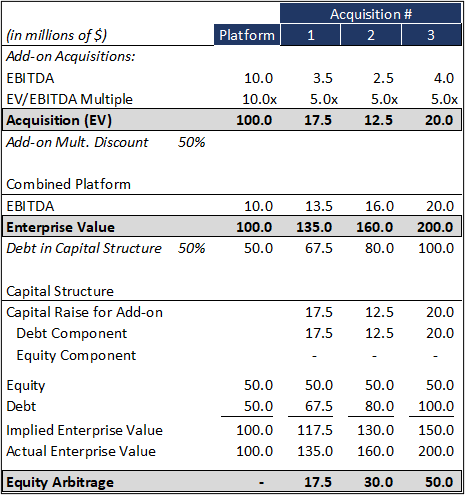
The following chart shows how three add-on companies, purchased at 5X multiples, are valued at a multiple of 10X once integrated with the platform company.
The following chart demonstrates a simple multiple arbitrage strategy:
In the above example, the initial acquisition (i.e., the platform company) was acquired at a 10x enterprise value (EV) to EBITDA (EV/EBITDA) multiple. The three subsequent acquisitions were completed at a 5x EV/EBITDA multiple.
If we assume that (1) the platform company acquisition was financed with 50% debt capital and 50% equity capital, (2) the acquisitions of the additional companies were financed entirely with debt capital, and (3) the consolidated entity added $10 million in EBITDA through the add-on companies, then the additional EBITDA would be valued at the platform company’s 10x multiple. As a result, the value of the additional $10 million of EBITDA would increase from $50 million to $100 million. This additional value is created exclusively through multiple arbitrage events before any operational adjustments.
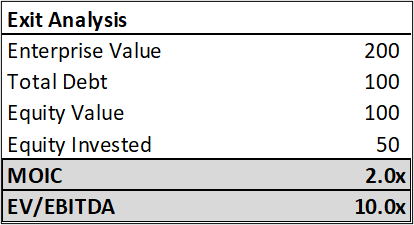
The next example includes the multiple on invested capital (MOIC), defined as the equity value at the time of exit divided by the initial invested equity. The MOIC of 2x represents a doubling of the invested capital because of the increased value created through association with the platform company.
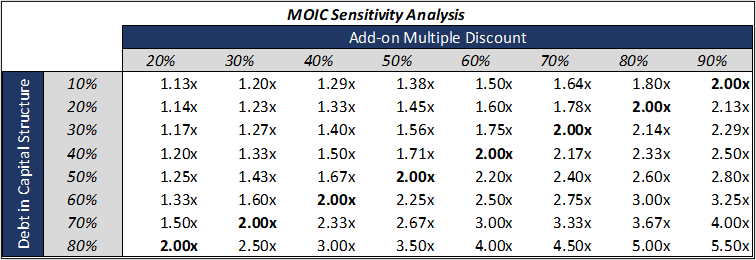
The final chart is a MOIC sensitivity analysis that demonstrates that the MOIC can range from 1.13x to 5.50x based on the amount of debt in the transaction’s capital structure and the assumed EBITDA multiples for add-on companies.
Financial Initiatives
The private equity investor can create incremental value through a roll-up strategy in several ways. There are many opportunities to improve operational performance through financial changes, such as (1) compatibility or mutually advantageous connections (synergies), (2) economies of scale, and (3) integrated cost savings.
Cross-Selling and Other Synergies
Cross-selling is the concept of delivering products and services traditionally sold to one set of customers to another set of customers. Examples of cross-selling opportunities include the following:
Selling complementary services
Bundling services or products
Expanding knowledge of customer buying habits within a particular sector
Utilizing preferential status (e.g., women-owner or minority-owned business) to obtain new contracts
Growing a more in-depth picture of the company’s landscape through new data
Utilizing the expertise of recently acquired sales staff to market to new customers
Economies of Scale
Economies of scale are intertwined with roll-up transactions because growing a business through acquisitions increases transaction volume. Economies of scale are defined as “cost advantages experienced by a firm when it increases the level of output. The advantage arises due to the inverse relationship between the per-unit fixed cost and the quantity produced.” [1] Economies of scale can be realized not only by spreading fixed costs over more revenue, but also through back-office synergies. Examples of back-office synergies include the following:
Shared expenses (accounting, finance, legal)
Increased buying power
Integrated Cost Savings
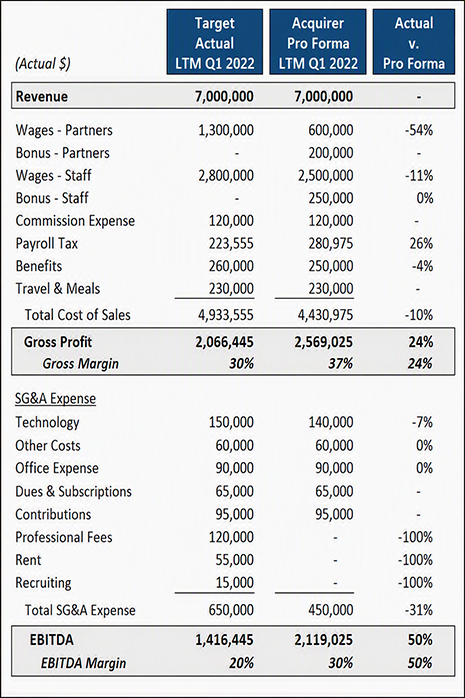
In addition to the above, there are other integrated cost savings that the acquiring party should analyze. Integrated cost savings eliminate common duplicate costs and provide opportunities for the combined entity to change compensation structures. Some of the more common adjustments to the target company’s adjusted projected income statement (pro forma income statement) in a roll-up acquisition include the following:
Owner/partner wages and bonus – These amounts are generally lowered to market levels with additional incentives provided in the form of either equity or earn-out payments.
Staff wages and bonuses – These amounts are often lowered due to either the employment of family members or duplicate roles.
Benefits cost – Economies of scale generally apply to employee benefits plans.
Technology/IT costs – Duplicative servers, IT personnel, and software costs are often eliminated.
Rent – Duplicative office and storage space is generally eliminated.
Recruiting – Larger organizations generally have lower incremental recruiting costs.
Other professional fees – Duplicative accounting and legal services are eliminated.
The following chart demonstrates the potential impact of the above income statement adjustments:
In this hypothetical example, the target company’s gross margin increased from 30% to 37% (a 24% increase), and EBITDA margin increased from 20% to 30% (a 50% increase).
Risks Involved in Roll-Up Transactions
Private equity investments, specifically roll-up transactions, are far from guaranteed and come with inherent risks. We will discuss the following financial, operational, and other categories of risk that can plague a roll-up transaction, such as:
Loss of key personnel
Over-leverage
Underperformance
Government regulation
Rate sensitivity
Integration complexities
Cultural clashes
Loss of Key Personnel
When private equity firms purchase smaller businesses to roll them up into the platform company, retaining key personnel is vital for a smooth transition. Retention is especially relevant in industries that rely on strong customer relationships. These include (1) family healthcare, (2) dental offices, (3) financial advisors, and (4) other industries with localized one-on-one service. Keeping these crucial individuals involved with the business can help preserve the customer base and reduce the risk that managers leave for competitors or depart to form competing businesses of their own. Retaining these managers and customer bases while adding value through scale and consolidation can improve customer experience and the value received by the retained base. Vendors also may have deep ties to managers, and losing a manager could jeopardize the relationship with key vendors.
Over-Leverage
Debt utilization can be a strategic tool for integrating companies into a platform firm, providing the necessary capital to facilitate acquisitions and growth. However, excessive debt can lead to significant negative consequences. The risk is that the required debt service can exceed the consolidated company’s available cash flow, particularly if the expected value creation from the roll-up does not materialize. This risk can become more pronounced if interest rates rise, because higher interest expense can further reduce cash flow available to operate the business, reinvest in growth, or support additional acquisitions.
Additionally, industries can lose growth opportunities due to regulatory changes or shifting market demand, leading to lower potential EBITDA multiples. Consequently, debt incurred to acquire firms under previous, more favorable valuation conditions may become burdensome in the current valuation climate. This scenario underscores the importance of carefully managing debt levels and continuously reassessing industry dynamics to ensure sustainable growth and value creation.
Debt liabilities of target acquisitions also need to be properly managed. Companies incorporated into the roll-up strategy that have significant outstanding debt can hurt the consolidated company when exiting the investment. While debt does not directly affect EBITDA multiples, it hurts the debt-to-EBITDA ratio, making the consolidated company less attractive to potential buyers. Additionally, more debt limits the investment available to implement cross-selling, upselling, branding uniformity, and other strategic opportunities to take advantage of the roll-up.
Underperformance
The risk of acquiring an underperforming add-on company can be mitigated through proper due diligence. A firm should understand the add-on company’s performance as a stand-alone unit and how the add-on company will perform when consolidated into the roll-up entity. The risk of failing to conduct adequate due diligence can lead to missed opportunities to capitalize on financial initiatives.
Merging companies can optimize operations, cut back-end costs, expand business units, and create cross-selling opportunities. However, failing to properly analyze the feasibility of achieving synergistic benefits could cause the consolidated company to miss its pro forma projections. For example, merging firms with highly specific, localized operations can hinder the ability to execute on synergies.
Consider the combination of a chiropractic firm that operates within a network of insurance companies with a firm that operates outside of health insurance financing. While an in-network firm would have access to a large customer base and receive regular referrals, it may be limited in the types of care insurance companies cover. Merging chiropractic firms with different operational structures may not work well. On the surface, the companies may appear compatible because they operate in the same market, but the operational structures of the two chiropractic practices may differ so much that the firms cannot realize the intended benefits.
Government Regulation
Government regulation and antitrust laws pose persistent risks in most investment actions that PE firms undertake. Specifically, the Federal Trade Commission (FTC) has increased its focus on private equity roll-ups, given the possibility that consolidated entities may result in monopolistic pricing.
This is illustrated in the following case: on May 20, 2025, the FTC finalized a consent order with Welsh, Carson, Anderson and Stowe settling allegations of anticompetitive conduct and price increases for consumers in anesthesia practices after purchasing and rolling smaller firms into United States Anesthesia Partners [2].
Separately, the Biden Administration also targeted non-compete clauses, with the FTC imposing a ban on non-compete clauses (non-competes) in 2024. However, the Trump Administration has shifted to a case-by-case enforcement approach, and currently, there is no nationwide non-compete ban. In pulling back from the previous nationwide ban, FTC Commissioner Andrew Ferguson said in a statement that the agency “will continue to enforce the antitrust laws aggressively against noncompete agreements.” He added that “firms in industries plagued by thickets of noncompete agreements will receive warning letters …urging them to consider abandoning those agreements as the Commission prepares investigations and enforcement actions.”
Additionally, several states have introduced or enacted their own laws restricting non-competes. Four states now ban non-competes entirely, 34 states plus the District of Columbia restrict their use, and 13 states enacted new restrictions in 2025. Consequently, regulatory review remains an important risk factor in roll-up transactions, particularly where consolidation could affect competition, pricing, or consumer choice. Therefore, valuation analysts should continue to consider regulatory risk when evaluating the reasonableness of projected synergies, exit timing, transaction costs, and valuation multiples in roll-up transactions.
Valuation Approaches
Regardless of the purpose of the private company's business valuation, the analyst should consider all three generally accepted approaches to valuation. Typically, analysts use one or more of these three approaches to estimate value. The objective of using more than one approach is to develop mutually supporting evidence as to the conclusion of value. While the specific title of these approaches may vary, the generic names are as follows:
The income approach,
The asset-based approach; and
The market approach.
Income Approach
The International Valuation Standards Glossary – Business Valuation defines the income approach as follows: “A general manner of estimating the value of an asset, business, or investment using one or more methods that convert expected economic income into a present amount.” The business appraisal profession generally recognizes the discounted economic income method, which is a multiperiod method, and the capitalization of economic income method, which is a single-period method. Each method is based on the economic principle that the value of an entity or asset is a function of the income it will generate over its expected life. The methods that can be used to estimate the value under this premise are based on two general procedures: (1) the estimation of an entity’s future economic earnings stream and (2) the application of an appropriate risk-adjusted present value discount rate.
Asset-Based Approach
The International Valuation Standards Glossary defines the asset-based approach as follows: “A general manner of estimating the value of a business using one or more methods based on a summation of the value of the assets, net of liabilities, where each has been valued using either the market, income, or cost approach.”
This method provides an indication of the value of the business enterprise by converting the balance sheet to economic value. The difference between the current values of the assets and liabilities is an indication of business value under the asset-based approach.
Market Approach
The International Valuation Standards Glossary defines the market approach as follows: “A general manner of estimating the value of an asset, business, or investment by using one or more valuation methods that compare the valuation subject to other assets, businesses, or investments that have been sold or for which price and other information is available.”
The two generally accepted methods under the market approach are (1) the guideline public company and (2) the guideline transaction methods.
The International Valuation Standards Glossary – Business Valuation defines the guideline public company method as follows:“A method within the market approach whereby market multiples are derived from market prices of stocks of companies that are engaged in the same or similar lines of business and that are actively traded on a free and open market.” [3] The purpose of compiling guideline company statistics is to develop valuation multiples based on prices at which stocks of sufficiently similar companies are trading in the public market.
The International Valuation Standards Glossary – Business Valuation defines the guideline transaction method as follows: “A method within the market approach whereby the value of a business is estimated by application of multiples derived from one or more transactions of controlling interests in companies engaged in the same or similar lines of business as the subject business.” [4] The purpose of compiling guideline transaction data is to develop valuation multiples based on prices at which sufficiently similar companies are sold.
The guideline public company approach allows analysts to use financial metrics from the valuation date [5]. Private companies used as comparisons for the guideline transaction method (GMAC) will not have public financial metrics available for the exact valuation date needed. Analysts may need to adjust market multiples to account for changes in economic and industry conditions between the date comparable information is available and the valuation date. Private companies cover a larger array of industries and revenue ranges that may be more relevant to the subject interest. This is one of the direct advantages of the GMAC.
Consideration of Formal Offers
Within the market approach, offers for the subject interest can provide another source of market-based evidence when evaluating value. This is particularly relevant in the context of private equity roll-up transactions because the implied multiples reflected in offers may help inform the analyst’s assessment of market participant pricing, especially when considered alongside multiples derived from the guideline public company method and guideline merged and acquired company method. In other words, the discussion of offers is important because a bona fide offer may provide direct evidence of how market participants value the subject business, including any expected benefits from consolidation, scale, or roll-up strategy.
Offers should not be viewed in isolation or automatically accepted as conclusive evidence of value. However, when an offer is made by a willing buyer with adequate knowledge of the relevant facts and without compulsion, it may indicate the business’s fair market value. This connection is important because fair market value is based on the price at which property would change hands in a hypothetical arm’s-length transaction between informed and willing parties.
Fair market value is defined in Treasury Regulation §1.170A-1(c)(2) as:
“The price at which property would change hands between a willing buyer and a willing seller, neither being under any compulsion to buy or to sell and both having reasonable knowledge of relevant facts.”
Treasury Regulation §20.2031-1(b) expands upon this definition:
“The fair market value... is not to be determined by a forced sale nor is the fair market value of an item to be determined by a sale within a marketplace other than that in which the item would be most commonly sold to the public, taking into consideration the location of the item wherever appropriate.”
The International Valuation Standards Council identifies the three most common sources of data used in the market approach: (1) public stock markets where ownership interests of similar businesses are traded, (2) the acquisition market where entire businesses are bought and sold, and (3) prior transactions in shares or offers for the ownership of the subject business.
Indicative and Formal Offers
There are two types of offers an analyst may consider when applying the market approach: (1) indicative offers and (2) formal offers. Indicative offers are based on early-stage information given at the discretion of the seller, represent estimated value indications before final due diligence is completed, and are not legally binding [6].
Formal offers are formed during a due diligence process with detailed information and provide a concrete price at which the acquirer is willing to close the deal [7]. Formal offers require a buyer to have the financial ability to consummate the offer transactions at arm’s length, defined as a business deal in which buyers and sellers act independently without one party influencing the other. Offers that do not follow through with financial consummation should be reduced in weight. An offer that is consummated after the valuation date can only be considered if the offer existed as of the valuation date.
Other factors to consider when analyzing and weighing offers to be used in a market approach include:
Whether parties acted rationally
Presence of representations and warranties
The forms and terms of payment
The terms of a management contract, if any, and its duration
Whether the offer was subject to regulatory or financing approval
Significant terms of non-competition and/or non-solicitation agreements
Whether the offer was bona fide and made in a transparent environment
Whether the offer provided sufficient details to estimate the cash equivalent value
Conclusion
Private equity roll-ups present a unique opportunity to increase value by rolling up multiple small firms into a platform company. These roll-ups can unlock cost-saving measures by spreading out and optimizing expenses. They also add value through cross-selling, upselling, and scaling opportunities. The principles of multiple arbitrage allow lower EBITDA multiples to multiply with the consolidation of these firms. Low-equity, high-debt transactions add to the intriguing strategy. There are three techniques used to value the roll-ups: The income approach, the market approach, and the asset-based approach. Using these techniques along with formal offers can provide a good indication of value.
Acknowledgments
J.S. Held thanks Riley Maleitzke for providing insight and expertise that greatly assisted this research.
Riley Maleitzke is a Consultant in J.S. Held’s Economic Damages & Valuation practice. He assists organizations in uncovering fraud, tracing funds, and mapping personal expenses for marital dissolution cases. Riley leverages his multidisciplinary experience to provide clients with comprehensive support in economic damages, business valuation, fraud examination, and financial data analysis in both domestic and cross-border matters.