Disclaimer: This article is not intended to offer any legal interpretation or opinion on the referenced court rulings. The author’s objective is to shed light on common challenges related to the standard-of-care opinion in the construction industry and to broaden construction professionals’ perspectives. The case law and rulings referenced herein were shortened and simplified for a non-expert audience. This should not be construed as the author's stance on similar cases.
Legal, insurance, and construction professionals should read this article to learn more about:
How standard of care extends beyond contracts when safety is implicated.
Why failure alone does not prove negligence.
Why code compliance is necessary but may still not be sufficient in satisfying the standard of care.
Why setting a higher bar may not necessarily guarantee a higher project delivery.
Ben draws on his background as a forensic structural engineer and experienced expert witness to assess how the professional standard of care is evaluated in construction disputes. In this paper, he examines recent Canadian and U.S. cases to show where courts challenge standard‑of‑care opinions beyond contracts, code compliance, and hindsight.
Executive Summary
This article examines how courts in recent Canadian and US construction disputes scrutinize and sometimes limit expert opinions on the professional standard of care. Drawing on multiple appellate and trial decisions, it shows that standard-of-care assessments cannot be downgraded to contract language, code compliance, or project outcomes alone. Courts emphasize professional reasonableness evaluated in context, particularly where public safety is at stake. Design failure, hindsight criticism, or non-compliance with minimum codes do not automatically establish negligence. The article highlights key grey areas practitioners and experts must navigate when framing, supporting, or challenging standard-of-care opinions in litigation.
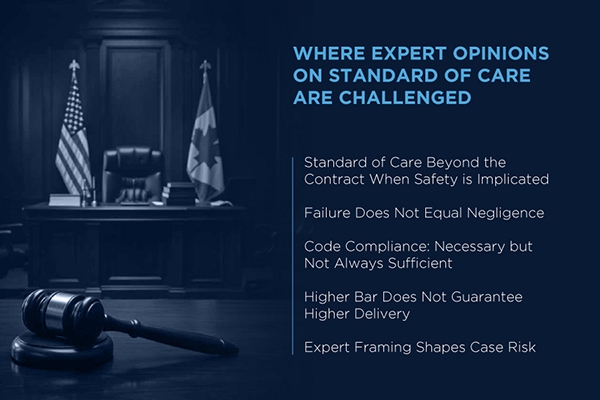
Figure 1: Standard of care in construction litigation: key considerations.
Introduction
Expert opinions on the standard of care are often required to determine whether practitioners—such as contractors, architects, engineers, subcontractors, city inspectors, acted prudently at the time, based on the information available to them. However, the standard of care is frequently the central point of contention in construction litigation, where experts, legal professionals, and sometimes the court itself may examine the same issue from different perspectives. Following a previously published article, “Explaining Standard of Care in Construction Disputes,” in which the author outlines the fundamental basis for standard‑of‑care assessment, this article reviews several recent and controversial Canadian and US construction cases in which expert witnesses were challenged on the boundaries of their opinions or where delicate aspects of the assessment were scrutinized at trial. Focusing on the technical rather than the legal reasoning of court decisions, this piece highlights a few practical grey areas where standard-of-care opinions are tested and, at times, curtailed.
Can Experts Expand the Standard of Care Beyond the Contract?
Yes! In Centurion Apartment Properties LP v. Sorensen Trilogy Engineering Ltd., 2024 [1]the British Columbia court ruled that the standard-of-care opinion may extend beyond the contractual boundaries.
The dispute arose from an 11‑storey residential apartment building in Langford, British Columbia, which was evacuated shortly after purchase due to serious structural safety concerns resulting from alleged design deficiencies. The expert witness opined that the structural engineer of record was responsible for producing a structurally sound and code-compliant design and for identifying and avoiding dangerous structural deficiencies that could pose risks to occupants, regardless of who retained the engineer, and irrespective of his contractual obligations.
Initially, the Supreme Court of British Columbia dismissed the claim against the engineer of record and rejected the expert witness's standard-of-care opinion, finding that such an opinion requires a contractual basis and that the particulars of the contractual matrix negated any duty of care owed by the engineer of record.
On appeal, the Court of Appeal overturned that ruling, finding that expert opinions on the standard of care cannot be confined to contractual wording when public safety is implicated. The Court emphasized that engineers may owe duties to future owners when the alleged negligence concerns dangerous defects that pose real and substantial safety risks, particularly where sudden or catastrophic failure is foreseeable. The Court rejected the notion that contractual arrangements automatically shield the design professionals from liability to downstream owners where alleged defects create a “real and substantial danger.”
Takeaways
Where construction defects pose a real and substantial risk to the public, the standard-of-care opinion may extend beyond privity of contract, even though legal professionals often tend to tie the standard-of-care opinion strictly to the fee, scope, or contract language. This case shows courts may override that framing, even when experts support it.
Does Improper Design Equate to the Breach of the Standard of Care?
No! In New England Building & Bridge, Inc. v. Town of Cohasset, 2024 WL 2304843 (D. Mass. May 21, 2024) [2] the Court found that the design inadequacy in the construction project did not necessarily meet the threshold for a standard-of-care violation.
The alleged design deficiency concerned the size of a drainage pipe specified by the project engineer for use during a dam rehabilitation project. The design drawings and specifications required the installation of a 30-inch-diameter pipe to convey water away from the work area and allow proper dewatering during construction. The owner relied on expert opinions contending that the specified pipe diameter was grossly undersized for the site conditions, resulting in damage and delays to the project.
The Court ruled that evidence of failure alone is not sufficient to establish negligence. Crucially, it rejected expert opinions that criticized outcomes without clearly anchoring those criticisms to an articulated professional standard of care. The judge emphasized that expert testimony must explain why the engineer’s judgment fell below accepted professional practice at the time, not simply that another solution would have performed better.
Takeaways
Evidence that a design was improper is, in fact, prima facie evidence and is not equivalent to a violation of the minimum applicable standards. To demonstrate a breach of the standard of care, it is necessary to establish a clear causal connection between the professional standards and the alleged breach before the court.
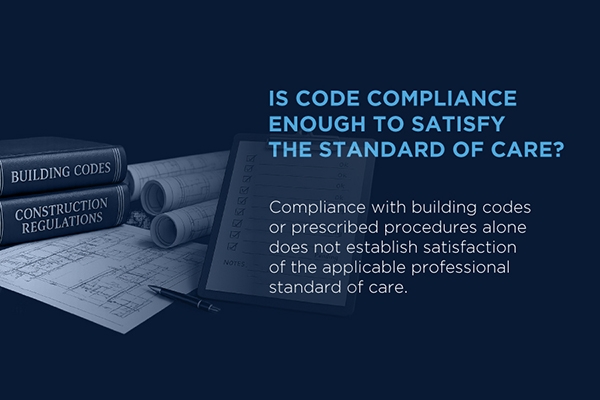
Figure 2: Performing work in compliance with building codes may not necessarily satisfy the standard of care.
Is Code Compliance Enough to Satisfy the Standard of Care?
No! The Illinois Appellate Court inAdrian Smith + Gordon Gill Architecture, LLP v. Chicago Shakespeare Theater (2024) [3] emphasized that the standard of care is governed by principles of professional reasonableness rather than by minimum statutory or code thresholds.
The case arose from a dispute involving design decisions for major architectural and building systems, in which the owner alleged professional negligence. In response, the defense relied, in part, on an expert opinion that the designs complied with the standard of care and that no explicit regulatory or statutory violations had occurred.
The Court underscored that expert testimony must articulate the recognized professional standard of care and explain how the professional’s conduct measured against that standard, not merely against the requirements of applicable codes. While code compliance may constitute relevant evidence, the Court made clear that it is not determinative of whether the standard of care was satisfied.
The Court stressed that evidence demonstrating only “what the code permits” does not address the main question of whether a reasonably prudent professional should have done more, given the specific project context.
Takeaways
This appellate decision provides a clear and explicit reminder that compliance with building codes or prescribed procedures alone does not establish satisfaction of the applicable professional standard of care.
Does Exercising the Standard of Care Guarantee a Flawless Outcome?
No! In Macy’s, Inc. v. H&M Construction Co., Inc., 2021, [4] the Federal Court of Appeals affirmed summary judgment that the standard of care is not a standard of perfection and that no practice is flawless.
The dispute arose from a post‑construction failure of a fire‑suppression sprinkler system that leaked years after installation, causing property damage. Macy’s alleged that the contractor’s work was defective and negligent, pointing in part to contractual language requiring that work be performed in a “first‑class and workmanlike manner.”
The court drew a clear distinction between contractual expectations of quality and the legal standard applicable to negligence claims. It emphasized that liability for professional or construction negligence is governed by an objective standard of reasonableness, i.e., what a reasonably prudent contractor would have done under similar circumstances at the time of construction, and not by whether the work ultimately proved unsuccessful.
The court held that the expert witness was required to present evidence establishing 1) the applicable standard of care in the construction industry, and 2) how the contractor’s conduct fell below that standard. The allegations, grounded in hindsight and performance‑based criticism, were insufficient to prove that the standard of care was breached, as the law does not impose a warranty of results on contractors. The mere fact that a system later malfunctioned did not demonstrate that the contractor acted unreasonably at the time of installation.
This decision is significant because the contract wording attempted to impose a higher standard on the contractor’s work, but the claim ultimately failed. Although parties can, in some circumstances, agree to a heightened standard of care through clear contractual language, that standard cannot be framed as an outcome-based expectation or as a guarantee of durability or error-free performance.
Takeaways
Compliance with the standard of care requires reasonable skill and judgment, not perfect results. A clear contractual language expressly imposing a higher standard may govern the professional practice; however, it cannot be tethered to a guaranteed result.
Conclusion
Drawing on recent Canadian and US caselaw, this piece highlights recurring grey areas in expert opinions on the standard of care. It shows how the standard of care can be framed differently in litigation, and why experts and instructing counsel should examine these opinions against the specific project context, particularly with respect to reasonableness, scope, extent, and the role (and limits) of contractual language.
Acknowledgments
J.S. Held would like to thank Ben Daee, Ph.D., P.Eng., PE, for providing insight and expertise that greatly assisted in this research.
Dr. Ben Daee is a qualified expert witness in J.S. Held's Forensic Architecture & Engineering Practice with a specialty in forensic investigation of complex construction claims/litigation matters, standard-of-care assessment, and root cause analysis. He regularly provides consultation to lawyers, insurance experts, contractors, manufacturers, owners, corporations, and municipalities in relation to complex civil engineering litigations and claims related to building/structural failure, property damage, design/build issues, foundation issues, material failures, subrogation matters, professional and municipal liability, and engineering error and omission. He represents contractors, consulting firms, builders, owners, and engineers in cases involving professional negligence, code compliance, design errors, and construction disputes.
Definitions & applications of standard of care in construction litigation, the roles of construction professionals and expert witnesses, and Canadian case laws....
Should an old cottage be upgraded to the current code by a new owner? When can a building component be “grandfathered?” Who should pay for the code upgrades following a property loss claim? These are...
Common issues that create potential for scaffold failures, preventative measures, and how to minimize the risk of collapse and other dangerous scenarios....
INDUSTRY INSIGHTS
Keep up with the latest research and announcements from our team.